Mini PC Cooling Technologies: Performance and Reliability Boundaries of Active, Heat Pipe, and Fanless Solutions
The rapid evolution of ultra-small form factor (USFF) PCs has forced a critical engineering challenge to the forefront: thermal management. Packing desktop-class processing power into a chassis smaller than a paperback book makes thermal dissipation the ultimate performance bottleneck. For hardware engineers, system integrators, and industrial deployment specialists, selecting the optimal thermal architecture is just as critical as choosing the CPU itself.
Below is a deep dive into the structural mechanics, performance trade-offs, and reliability boundaries of the three primary Mini PC cooling methodologies: Active Fan Cooling, Heat Pipe Integration, and Fanless (Passive) Thermal Design, followed by real-world industrial benchmarks and specialized hardware implementations.
Structural Mechanics: How Each Thermal System Works
Understanding the core physical mechanisms of each thermal architecture is essential for predicting hardware behavior under continuous computational loads.
Active Fan Cooling: Forced Convection Dynamics
Active cooling relies on forced convection to move thermal energy away from silicon. The architecture pairs a copper baseplate mounted to the CPU thermal spreader with a dense array of aluminum cooling fins. High-RPM centrifugal blowers or axial fans push air through these confined internal channels.
The Constraint: Airflow volume ($CFM$) inside an ultra-compact chassis is severely restricted by spatial limitations, requiring higher fan speeds to generate the necessary static pressure.
Heat Pipe Integration: Phase-Change Thermal Superhighways
Heat pipes act as rapid thermal conductors rather than standalone heat sinks. A heat pipe is a vacuum-sealed copper tube containing a working fluid (typically distilled water) and an internal sintered or grooved capillary wick structure.
Evaporation Phase: CPU heat vaporizes the working fluid inside the hot end.
Vapor Migration: Vapor travels rapidly through the low-pressure core to the cooler condenser section near the exhaust fins.
Condensation Loop: The vapor condenses back into liquid upon releasing its latent heat, and capillary action returns it along the internal wick to the evaporator.
The Advantage: This two-phase latent heat transfer achieves effective thermal conductivity thousands of times higher than solid copper blocks of equivalent mass.
Fanless (Passive) Architecture: Conduction and Natural Heat Dissipation
Fanless cooling completely eliminates mechanical moving parts, transforming the outer metallic enclosure into an integrated thermal radiator.
Direct Conduction: A heavy-duty solid copper thermal block paired with high-conductivity Thermal Interface Material (TIM) links the CPU directly to the external aluminum chassis.
Fin Topology: Deeply grooved, widely spaced exterior vertical fins maximize surface area, facilitating natural convection (hot air rising to draw cool ambient air from below) and thermal radiation.
Tolerance Engineering: Absolute precision in manufacturing tolerances is essential; microscopic air gaps between the thermal conduction block and outer chassis drastically degrade thermal dissipation.
Full-Load Thermal & Acoustic Performance Profiles
When subjected to continuous 100% computational workloads (such as sustained AI inference, multi-channel edge processing, or 4K rendering), the operational boundaries of each thermal design become distinct.
| Performance Metric | Active Fan Cooling | Heat Pipe + Fan Hybrid | Premium Fanless Architecture |
| Typical Core Temp (Full Load) | 75°C – 85°C | 70°C – 80°C | 85°C – 95°C (Stabilized) |
| Acoustic Output (dBA) | 40 – 52 dBA (High-Pitch Airflow) | 35 – 45 dBA (Moderate Whining) | 0 dBA (Absolute Silence) |
| Thermal Throttling Risk | Low (Vents must remain unblocked) | Very Low | Moderate to High (Requires BIOS TDP tuning) |
| Sustained CPU TDP Range | Up to 45W – 65W | Up to 65W – 95W+ | Limited to 15W – 35W (Chassis dependent) |
Core Temperature & Clock Frequency Stability
Active and heat-pipe hybrid systems react rapidly to thermal transients, dumping heat away from the silicon to maintain core temperatures safely below the junction limit ($T_{j\text{max}}$). Fanless systems exhibit high thermal inertia: internal core temperatures rise steadily over 20 to 45 minutes until the chassis achieves thermal equilibrium with ambient surroundings. Consequently, fanless systems rely on optimized BIOS power targets (PL1/PL2 thresholds) and lower-TDP mobile processors to prevent aggressive thermal throttling.
Acoustic Profiles
Small fans inside compact enclosures typically operate between 3,000 and 5,000 RPM, producing noticeable high-frequency acoustic noise. Fanless systems operate at 0 dBA, generating zero electrical or mechanical noise—making them imperative for noise-sensitive deployments such as recording studios, medical suites, and acoustic laboratories.
Industrial Reliability and Harsh-Environment Standards
Deploying Mini PCs in manufacturing facilities, outdoor digital kiosks, marine vessels, or vehicular systems exposes hardware to severe environmental stress.
Mechanical Vulnerabilities of Forced Airflow
The HYSTOU Business Mini PC‘s small footprint allows multiple units to be installed in the space occupied by a single traditional desktop. ThisStandard internal active fans represent the primary point of failure in rugged environments. Intake vents draw in ambient airborne contaminants—including conductive dust, oil vapors, and humidity. These particulates accumulate across cooling fins, degrade fan bearings, and cause short circuits or rapid thermal failures. feature also facilitates custom dedicated server setups, helping organize office areas into clean, comfortable workplaces that enhance employee efficiency and company productivity.
Ruggedization Engineering Principles
In a market flooded with generic mini PCs, HYSTOU stands out with its focus on business-grade reliability. Every unit undergoes rigorous testing to ensure 24/7 operation, and the company offers a 3-year warranty—unheard of in the consumer electronics space. Their customer support team specializes in small business needs, guiding you through configuration, installation, and upgrades.
But don’t just take our word for it. Over 5,000 small businesses worldwide have made the switch, with 94% reporting measurable cost savings within the first year. As one satisfied customer put it: “The HYSTOU Business Mini PC isn’t just a computer—it’s a cost-cutting tool that pays for itself in under 10 months.”
Innovative Industrial Applications: Hystou Hardware Ecosystem
To resolve the trade-offs between thermal performance, dust isolation, and specialized interface requirements, Hystou has developed specialized Mini PC thermal architectures tailored to distinct operational demands.
Hystou H4-12th-V2: Targeted External-Fan Sealed Architecture
The Hystou H4-12th-V2 addresses traditional active cooling vulnerabilities by separating internal electronics from external forced airflows.
Direct Copper Conduction to Chassis: Internal CPU thermal energy is conducted via a heavy-duty copper block straight to the metallic chassis shell.
Targeted External Forced Airflow: The cooling fan is mounted entirely on the exterior of the chassis, drawing fresh air and directing it specifically at the external chassis region closest to the CPU.
Zero Internal Dust Accumulation: Because no air intake vents enter the inner motherboard housing, the mainboard compartment remains completely sealed. Any airborne dust pulled by the fan stays strictly on the exterior shell, offering the sustained performance of active cooling paired with the dust isolation of a fanless design.
Hystou Industrial Fanless Series: High-Reliability Deployments
For deployments demanding total silence, zero moving parts, and specialized industrial bus communication, Hystou’s fanless lineup covers diverse operational requirements:
Hystou K4 Series: Engineered for harsh factory floors, utilizing a heavy-duty extruded aluminum chassis rated for stable operation between -20°C and +60°C.
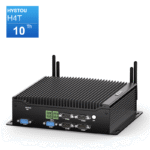
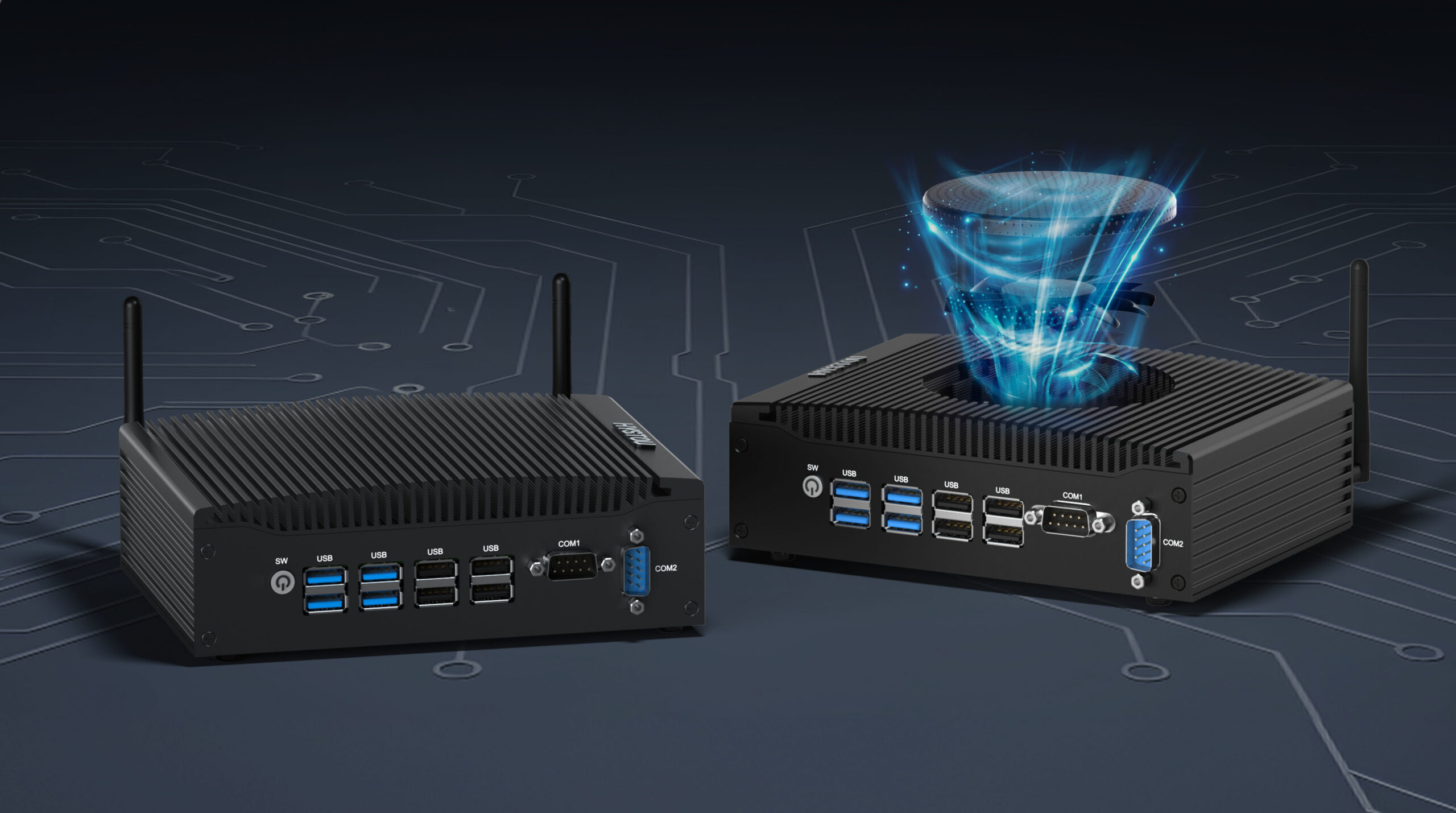
Hystou H4-T Industrial Workstation: Built for industrial automation and edge compute applications operating in -10°C to +55°C environments. The H4-T integrates extensive industrial I/O, including 6*DB9 COM ports (RS232/RS422/RS485), an 8-channel GPIO interface, dual Intel gigabit LAN ports, and native CAN Bus protocol support for direct integration with industrial controllers, PLC systems, and automotive networks.
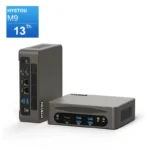
Hystou M9 High-Performance Compact Workstation: Designed for high-speed connectivity and demanding edge tasks, featuring a single Thunderbolt 4 port for high-throughput peripheral expansion.
Deployment Selection Matrix
Selecting the appropriate thermal architecture requires matching compute requirements to environmental exposure:
Deploy the Hystou H4-12th-V2 (External Fan) when sustained high CPU boost clocks are required in environments with ambient airborne dust, ensuring maximum processing performance while maintaining internal component isolation.
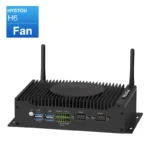
Deploy Hystou Fanless Systems (H4-T / K4 / H6) when environments mandate completely silent operation (0 dBA), maintenance-free 24/7 reliability, extended operating temperatures, resistance to mechanical vibration, or native protocol support like CAN Bus and multi-serial interfaces.

Author: Nick FU
Marketing Specialist | HYSTOU Mini PC & Network Appliance Manufacturer
HYSTOU has established its R&D headquarters in Shenzhen, drawing on over a decade of experience. Our core team members, who previously served at renowned companies such as Inventec and Quanta Computer, form the backbone of our technical expertise. With robust R&D and innovation capabilities, we remain steadfast in our commitment to pursuing excellence in the field of technology products.