What Can a Mini PC Do? 11 Modern Applications & Buying Guide
Mini PCs Are Not "Low-End Desktops"
Many people’s first reaction to a Mini PC is: “Such a small machine—what can it do? The performance must be worse than traditional desktops.” This skepticism seems reasonable, but it overlooks a core point—performance is never the only metric for computing devices.
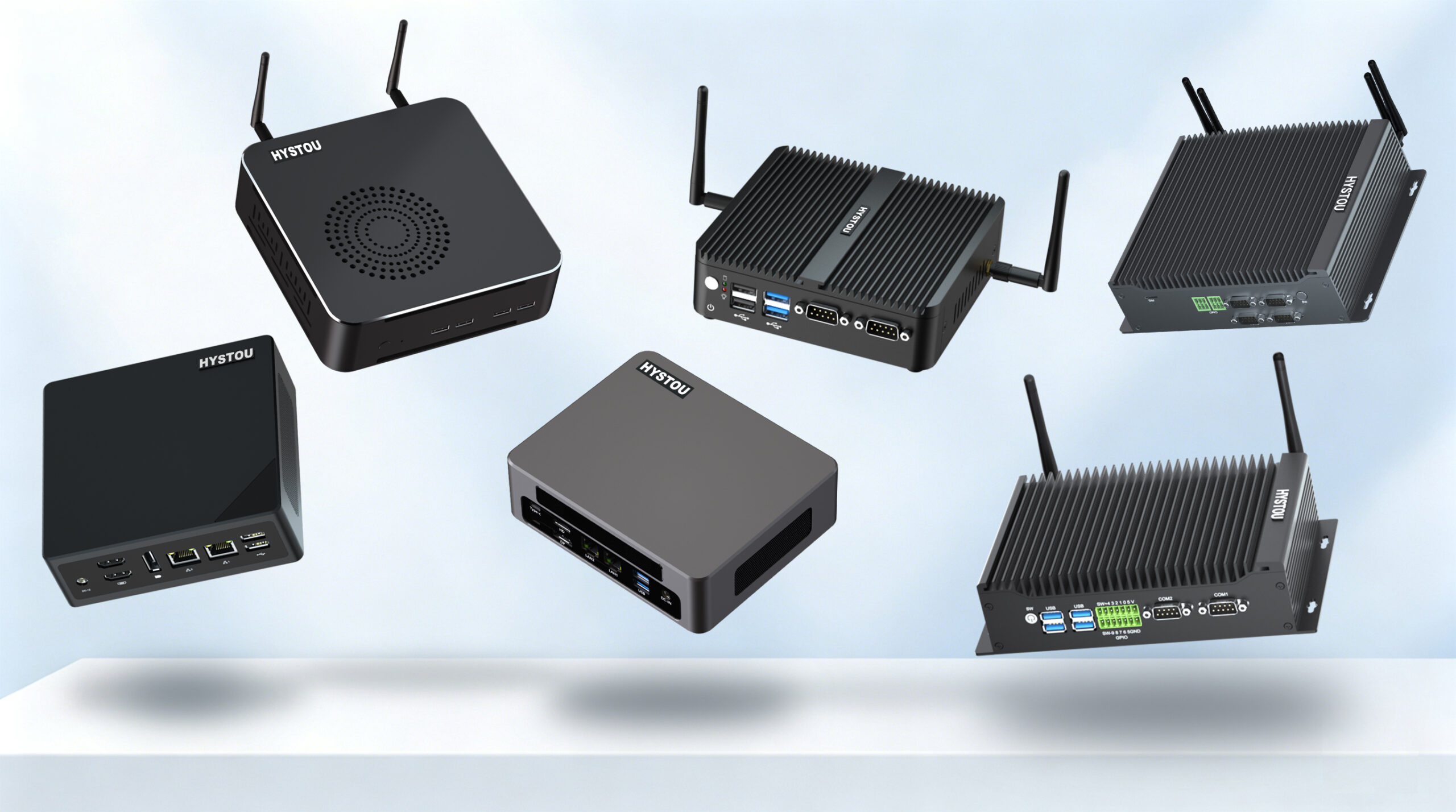
In fact, Mini PCs were not designed to “replace desktops.” Their design philosophy is achieving optimal solutions for specific scenarios. Desktops pursue extreme performance, industrial Mini PCs pursue stability and reliability, while consumer Mini PCs pursue energy efficiency, space efficiency, silent operation, and plug-and-play simplicity.
Mini PC vs Desktop: Not Replacement, But Complementarity
| Aspect | Desktop | Consumer Mini PC | Industrial Mini PC |
|---|---|---|---|
| Core Goal | Extreme performance | Energy efficiency & space | Stability & reliability |
| Typical Power | 150-600W+ | 15-65W | 10-50W |
| Size | 15-30 liters | Under 1 liter | 1-3 liters |
| Environment | Standard office | Home/office | -40°C to 85°C wide temp |
| Operation Time | 8-hour workday | 8-16 hours | 24/7 continuous |
| Best For | Heavy gaming, 3D rendering | HTPC, office, light gaming | Industrial, medical, security |
So, what can a Mini PC do? Below, I’ll break down 11 major application scenarios from both consumer and industrial perspectives.
Part 1: Consumer Mini PC Application Scenarios
Consumer Mini PCs target individual and home users, pursuing cost-effectiveness, silent operation, and ease of use. Here are 5 typical scenarios:
Scenario 1: Home Theater (HTPC)
Mini PCs are ideal for building home theater systems. They can be installed in TV cabinets, connected to large-screen TVs via HDMI, and deliver 4K or even 8K Ultra HD video playback.
- Silent design: Fanless or low-noise fans, no disturbance during viewing
- Low power: Can stay on 24/7, instant on/off
- Hardware decoding: Supports HEVC/H.265, VP9, AV1 for 4K/8K
- Compact size: Hidden in TV cabinets, keeps the living room tidy
Scenario 2: Office Workstation
For daily office needs, Mini PCs offer excellent value. They handle documents, spreadsheets, and video conferencing smoothly while occupying minimal desk space.
- Space saving: VESA-mount behind monitors
- Lower energy: 1/5 of desktop power, saves ~75% electricity over 3 years
- Easy deployment: Plug-and-play, low IT management cost
- Multi-display: Easily connect 2-4 monitors
Scenario 3: Software Router (Soft Router)
Mini PCs are popular for building software routers. Compared to traditional routers, they offer more powerful network management with multi-WAN, traffic control, VPN, and ad blocking capabilities.
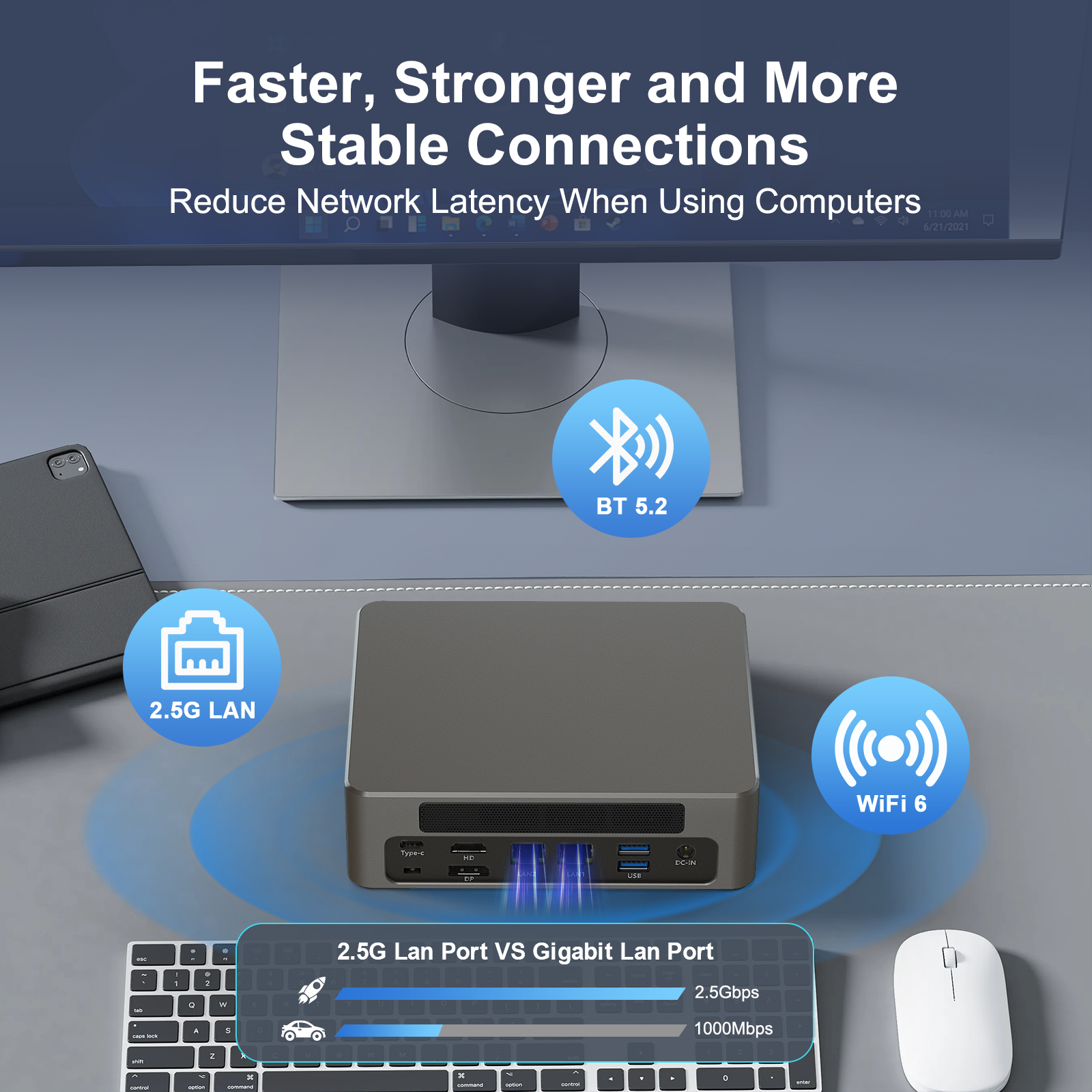
- Ultra-low power: Only 10-25W, runs 24/7
- Powerful features: Compatible with iKuai, OpenWrt, pfSense
- Multi-purpose: Router, NAS, and download station combined
- Flexible expansion: Configure multiple ports for complex networks
Scenario 4: Light Gaming
While Mini PCs aren’t for hardcore AAA gamers, models with high-performance integrated graphics can smoothly run popular esports and light 3D games.
- Compact size: Perfect for living room entertainment
- Strong iGPU: AMD Radeon 780M comparable to GTX 1650
- Lower power: ~65W during gaming
- Expandable: Some support external GPU enclosures
Scenario 5: Home Server & NAS
Mini PCs can transform into low-power home servers, serving as file storage, media library, download station, and home automation hub—more flexible than traditional NAS devices.
- Ultra-low power: Only 15-35W, low long-term operating cost
- Flexible software: TrueNAS, Unraid, Synology compatible
- Docker support: Run Plex, Jellyfin, Home Assistant, etc.
- Low noise: Suitable for bedroom or living room placement
Part 2: Industrial Mini PC Application Scenarios
Industrial Mini PCs feature wide temperature operation, vibration resistance, fanless design, and rich interfaces. They are widely used in harsh environments and professional fields. Here are 6 typical scenarios:
Scenario 6: Industrial Control & Automation
In factory automation, Mini PCs serve as industrial hosts for monitoring, control, and data acquisition. They replace traditional bulky industrial computers while providing stronger computing power.
- Wide temperature: Operates from -40°C to 85°C
- Vibration resistant: Designed for industrial vibration environments
- Fanless: Prevents dust ingress, ideal for dusty workshops
- Rich interfaces: RS232/485 serial ports, GPIO, LAN, etc.
Scenario 7: Medical Equipment
The medical industry has extremely high requirements for device stability and safety. Mini PCs are widely used in medical imaging terminals, EHR systems, and surgical room control equipment.
- Silent & fanless: Prevents cross-infection, suitable for ORs
- Stable & reliable: 24/7 continuous operation
- Easy to sanitize: Smooth surface, easy cleaning
- Low heat: Reduces thermal load in medical environments
Scenario 8: Smart Manufacturing & Edge Computing
In smart factories, Mini PCs serve as edge computing nodes for local data processing, AI inference, and machine vision. They deploy near production lines for low-latency response.
- Low latency: Local data processing, millisecond response
- Low power: Ideal for distributed deployment
- AI acceleration: Intel NPU or NVIDIA Jetson support
- Compact design: Install inside equipment or tight spaces
Scenario 9: Transportation & Vehicle Systems
In rail transit, maritime, and vehicle applications, Mini PCs serve as the core for control, monitoring, and entertainment systems. They must withstand vibration, humidity, and temperature fluctuations.
- Shock resistant: Passes ISO 16750 vibration testing
- Wide temp: Operates from -30°C to 70°C
- Flexible power: Supports 9-36V DC input
- Compact mounting: Embeds in consoles or cabinets
Scenario 10: Security Surveillance Systems
In security monitoring, Mini PCs serve as NVRs (Network Video Recorders) or video analytics servers, managing dozens of cameras and performing real-time AI analysis.
- Low power: 24/7 operation, lower electricity costs
- Multi-port: Direct connection to camera networks
- AI analytics: Face recognition, behavior analysis, etc.
- Stable: Ideal for unattended server rooms
Scenario 11: Self-Service Kiosks & Digital Signage
In retail, dining, banking, airports, and more, self-service kiosks and digital signage are everywhere. Mini PCs are the core control units for these devices.
- Compact size: Hidden inside terminals
- Stable operation: 24/7 continuous duty
- Remote management: Intel vPro, AMT support
- Multi-display: 4K dual-screen or video wall support
Consumer vs Industrial: Mini PC Comparison Summary
From the analysis above, we can see that consumer and industrial Mini PCs, while similar in size, differ significantly in design philosophy and application scenarios:
| Aspect | Consumer Mini PC | Industrial Mini PC |
|---|---|---|
| Target Users | Individuals, homes, small businesses | Industrial enterprises, integrators, and government |
| Environment | Standard indoor (10-35°C) | Harsh conditions (-40°C to 85°C) |
| Operation Time | 8-16 hours/day | 24/7 continuous |
| Cooling | Fan-based primarily | Fanless passive cooling |
| Interfaces | USB, HDMI, Ethernet, audio | Serial (RS232/485), GPIO, isolated I/O |
| Power | AC 220V adapter | DC 12-48V / AC/DC |
| Supply Cycle | 1-2 years rapid iteration | 5-7 years extended availability |
| Certifications | CCC, CE, FCC | CCC, CE, FCC + Industrial/Medical |
| Price Range | $70-700 | $400-3000+ |
5 Key Questions When Buying
- Is it environment-friendly? Verify temperature, humidity, and vibration requirements.
- Are the interfaces sufficient? Check USB, display, Ethernet, and serial port quantities.s
- What’s the power requirement? Confirm power specs (AC/DC, voltage range)
- How will it be mounted? VESA, DIN rail, or wall mount—confirm the method
- What’s the supply cycle? Industrial use requires a 5+ year supply guarantee
FAQ
1. What's the difference between Mini PC and NUC?
NUC (Next Unit of Computing) is a Mini PC standard introduced by Intel. Mini PC is a broader concept that includes NUC products, OEM custom products, and industrial-grade products.
2. Can industrial Mini PCs be used in normal environments?
Absolutely. Industrial Mini PCs have comparable performance to consumer Mini PCs, just with higher reliability designs. In normal environments, industrial products offer even better stability and longevity.
3. How long do Mini PCs typically last?
Consumer Mini PCs average about 5 years, while industrial Mini PCs can last 7-10 years. Since CPUs and GPUs are usually non-replaceable, you may need to replace the entire unit when performance no longer meets needs.
4. Can Mini PCs be DIY-upgraded?
Most Mini PCs support RAM and storage upgrades, but CPUs and GPUs are typically fixed. Some modular designs (like Framework products) support more component upgrades.
5. How do I decide between consumer and industrial Mini PC?
Mainly consider the operating environment and duration. Consumer grade is fine for standard office environments with 8-hour daily use. For harsh environments, 24/7 operation, or special certification requirements, choose industrial grade.

HYSTOU
HYSTOU has established its R&D headquarters in Shenzhen, drawing on over a decade of experience. Our core team members, who previously served at renowned companies such as Inventec and Quanta Computer, form the backbone of our technical expertise. With robust R&D and innovation capabilities, we remain steadfast in our commitment to pursuing excellence in the field of technology products.