Local AI has shifted from a niche tech trend to an everyday productivity tool for both home and business users. Cloud-based AI tools come with clear tradeoffs: data privacy risks, internet dependency, and noticeable latency. High-power GPU desktops deliver strong AI performance, but they take up too much desk space, consume excessive power, and generate constant noise.
This is where the NPU mini PC steps in. It combines the compact form factor of a mini computer with dedicated on-device AI acceleration, creating a balanced solution for most users. In this guide, we break down what an NPU mini PC is, its core advantages, real-world performance, and how to pick the right category for your needs.
What Is an NPU Mini PC?
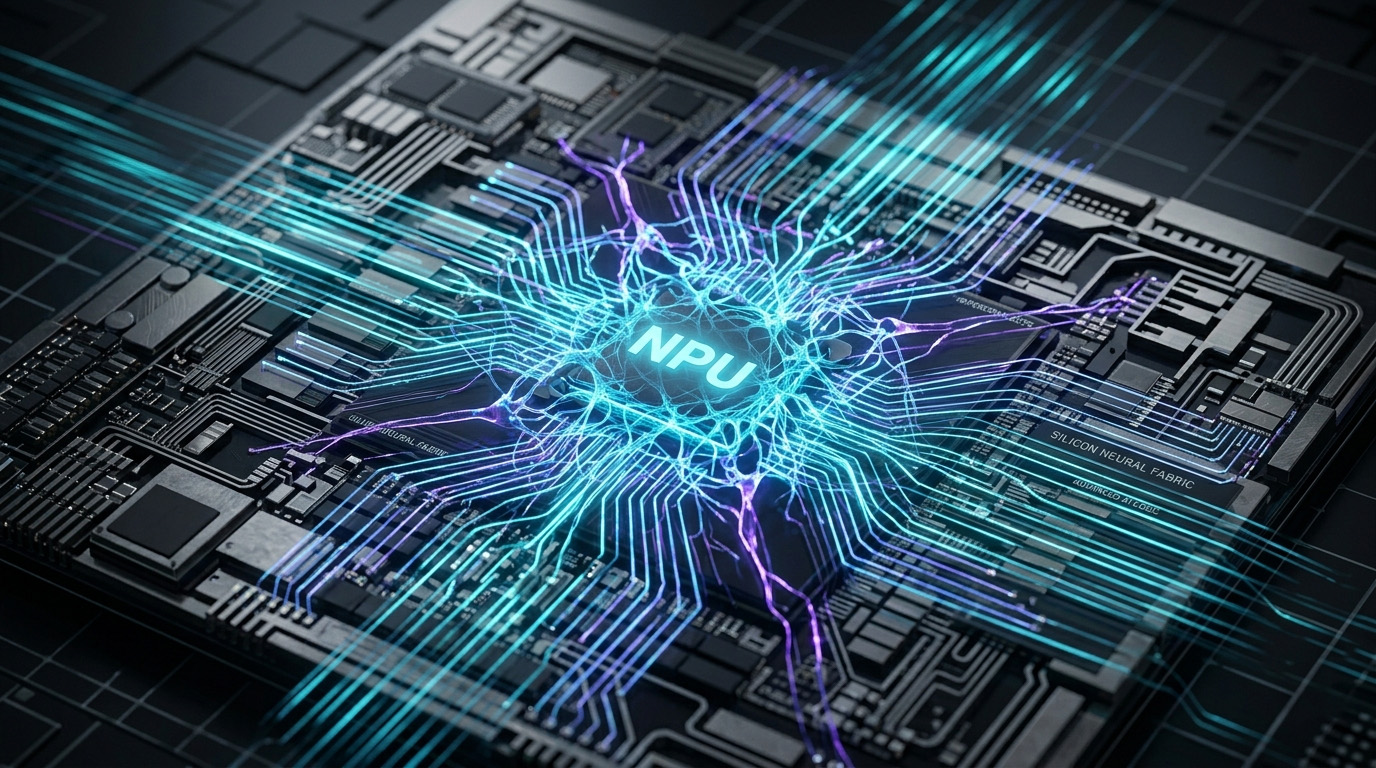
An NPU mini PC is a compact, small-form-factor desktop computer integrated with a dedicated Neural Processing Unit (NPU). It delivers energy-efficient on-device AI acceleration for productivity, local large language models, and edge computing tasks, all within a low-power, space-saving chassis.
Crucial Hardware Note: When choosing an NPU Mini PC for running local LLMs (like Llama 3), RAM capacity and bandwidth are your primary bottlenecks. For instance, while Intel’s Lunar Lake offers excellent NPU efficiency, its Memory on Package (MoP) architecture limits onboard memory to 32GB LPDDR5X. If your goal is running 32B+ parameter models, you must pivot to platforms that support 64GB or higher, such as top-tier AMD Ryzen AI processors.
To understand an NPU mini PC in depth, you first need to know how an NPU works. Short for Neural Processing Unit, an NPU is a specialized piece of hardware designed exclusively for AI inference and machine learning tasks.
How an NPU differs from CPU and GPU
- A CPU acts as a general-purpose manager. It handles all kinds of daily computing tasks but runs at low efficiency for parallel AI calculations.
- A GPU focuses on parallel graphics rendering. It can run heavy AI workloads, but it consumes high power and generates significant heat.
- An NPU serves as a dedicated AI specialist. It processes matrix operations for AI models with far higher efficiency and lower power draw.
An NPU mini PC integrates this dedicated AI chip into a small-form-factor desktop. It retains all core advantages of a standard mini PC — compact size, low power use, and quiet operation — while adding native AI acceleration.
In fact, the rise of Microsoft Copilot+ has set a clear industry benchmark. Devices with at least 40 TOPS of NPU performance qualify for Copilot+ certification, unlocking system-level AI features like live meeting transcription, document summarization, and real-time language translation.
How it stands out from other mini PCs
- Compared to a basic mini PC: An entry-level mini PC relies solely on its CPU for AI tasks. This slows down overall system performance and limits the complexity of AI models you can run.
- Compared to a GPU mini gaming PC: A discrete GPU mini PC delivers higher raw AI performance, but it costs more, runs hotter, and requires a larger chassis. It fits heavy AI creators and gamers, not everyday office or edge deployment use cases.
Core Benefits of an NPU Mini PC
NPU mini PCs are gaining global traction for good reason. They solve key pain points that come with both cloud AI and GPU-based local AI setups.
1. On-device data privacy and security
All AI calculations run directly on the local hardware. No sensitive data — business documents, personal files, or industrial sensor data — needs to be uploaded to a third-party cloud server.
This level of privacy is critical for corporate teams, industrial facilities, and users who handle confidential information. It eliminates the risk of data leaks during transmission or cloud storage.
2. Ultra-high energy efficiency and quiet operation
NPU architecture is built for low-power AI workloads. For the same AI inference task, an NPU uses roughly one-third to half the power of a discrete GPU.
Lower power consumption means less heat generation. Most NPU mini PCs work with compact cooling systems, and many fanless NPU mini PC models can run completely silently. This makes them ideal for 24/7 operation in office, home, or industrial environments.
3. Native system-level AI experience
Certified Copilot+ mini PCs work seamlessly with built-in Windows AI features. You do not need to install extra software or set up complex configurations.
Background AI tasks run on the NPU without taking up CPU or GPU resources. Your regular work, streaming, or browsing will stay smooth even when AI tools are active.
4. Cost-effective AI capability
You do not need to pay for an expensive dedicated graphics card to get reliable local AI performance. An NPU mini PC delivers usable AI acceleration at a much lower entry price point.
For most everyday office and light AI users, this delivers better value than a high-end GPU mini PC.
5. Versatility across consumer and industrial use cases
The same NPU mini PC platform works for multiple scenarios.
For home and office users, it handles productivity AI and media enhancement. For industrial users, it supports edge computing, machine vision, and on-site data analysis in compact enclosures.
NPU Mini PC Performance: What Can It Actually Do?
Many buyers fixate on peak TOPS numbers when evaluating NPU performance. In reality, real-world experience depends on far more factors.
Memory capacity, memory bandwidth, software optimization, and sustained cooling all play bigger roles than a single peak performance spec.
Mainstream NPU platform comparison (2026 Industry Standards)
Three main platforms dominate the 2026 NPU mini PC market. Each targets different user groups and uses cases with distinct hardware limits and ecosystem support.
| Platform | NPU Architecture | Peak NPU Performance | Maximum Memory Support | Core Software Ecosystem | Best For |
|---|
| AMD Ryzen AI 300 Series | XDNA 2 | 50+ NPU TOPS | Up to 64GB/128GB LPDDR5X | Mature Ollama / llama.cpp, Amuse AI | Local AI enthusiasts, developers, and power users |
| Intel Core Ultra (Lunar Lake) | NPU 4.0 | Up to 48 NPU TOPS | Up to 32GB LPDDR5X (MoP) | Robust OpenVINO ecosystem, Intel AI PC SDK | Business offices, secure corporate deployment |
| Qualcomm Snapdragon X Elite | Hexagon NPU | 45 NPU TOPS | Up to 64GB LPDDR5X (Unified) | Native Windows on ARM, Qualcomm AI Stack | Ultra-low-power, silent, and highly efficient workflows |
Real-world performance by use case
Raw numbers do not tell the full story. Here is what you can actually do with a modern NPU mini PC.
Daily office productivity
For document summarization, email drafting, live meeting notes, and real-time translation, NPU acceleration runs completely in the background.
It does not slow down your word processor, spreadsheet, or browser. Most users will not even notice it working, while getting a clear boost to work efficiency.
Local large language modelsv
A 40 TOPS class NPU mini PC with 32GB of RAM can run 7B to 13B parameter models smoothly via Ollama. Typical speeds range from 30 to 50 tokens per second.
High-end 50+ TOPS models paired with 64GB or more memory can handle 32B parameter models comfortably. This works for private AI assistants, local knowledge bases, and small team use.
Creative and multimedia tasks
NPU acceleration speeds up common media workflows significantly. It handles AI photo noise reduction, voice-to-text transcription, and video frame interpolation 3 to 5 times faster than pure CPU processing.
For casual content creators, this removes the need for a separate high-end GPU for basic editing tasks.
Industrial edge computing
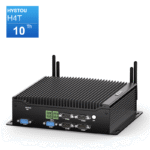
Fanless NPU Mini PCs are revolutionary for factory automation and machine vision. By processing inference workloads locally via the NPU, these systems maintain a low thermal profile (typically 10W–15W idle TDP), eliminating the need for cooling fans.
Look for models equipped with dual LAN ports, COM (RS232/RS485) interfaces, and CAN Bus protocols to ensure seamless integration with industrial sensors and legacy factory equipment in dusty or wide-temperature environments.
NPU performance tiers and matching user groups
- Under 20 TOPS: Basic office AI acceleration. Best for users who only need system-level Copilot features for light office work.
- 40 TOPS class: Full Copilot+ support and smooth 7B–13B local model operation. The sweet spot for most home and office users.
- 50+ TOPS: High-end local AI performance for 32B+ large models. Ideal for AI enthusiasts, small studios, and edge computing deployments.
Top Picks: Which Type of NPU Mini PC Is Right for You?
There is no single best NPU mini PC for every user. The right choice depends on your use case, budget, and deployment environment. Below are the top categories to consider, with clear criteria to match your needs.
Best for everyday office use
Look for a 40 TOPS class NPU platform with 16GB to 32GB of RAM and 512GB to 1TB of SSD storage.
Prioritize stable driver support, quiet cooling, and common office interfaces like dual display outputs and USB ports. These models strike the best balance of price and performance for regular home office and business teams.
Best for local AI enthusiasts
Opt for a 50+ TOPS high-performance NPU platform with at least 64GB of upgradeable RAM.
Prioritize high memory bandwidth, multiple M.2 storage slots, and good software compatibility with popular local AI tools. These models handle larger language models and more complex AI workloads with ease.
Best for industrial edge deployment
Opt for a fanless industrial NPU mini PC built with industrial-grade components and wide operating temperature support. Prioritize models with integrated dual LAN ports, COM (RS232/RS485) interfaces, CAN Bus protocols, watchdog timers, and PXE boot functionality.
For 24/7 factory and field deployment, long-term reliability and peripheral compatibility take priority over raw peak NPU performance. Always select units with official safety and compliance certifications for your target regional markets.
Best for budget-conscious buyers
Stick to an entry-level 20+ TOPS NPU platform with 16GB of RAM and 512GB storage.
These models still support basic system AI features and light local model use. They work well for casual users who want AI capability without paying a premium for top-tier specs.
Common Myths About NPU Mini PCs
As with any fast-growing tech category, plenty of misinformation circulates about NPU mini PCs. Here are three common myths to watch for.
Myth 1: Higher TOPS always means better AI performance
Peak TOPS only measures maximum theoretical performance under ideal conditions.
In real use, software optimization, memory bandwidth, and sustained cooling have a much larger impact on user experience. A well-optimized 40 TOPS system often outperforms a poorly optimized 50 TOPS system.
Myth 2: An NPU can replace a dedicated GPU
An NPU excels at AI inference tasks, but it cannot handle graphics rendering for gaming or heavy 3D design work.
If you plan to play AAA games, run AI image generation at scale, or train custom models, a GPU mini PC will still be the better choice. An NPU mini PC complements, rather than replaces, high-end GPU systems.
Myth 3: Any NPU mini PC can run all large language models
NPU performance is not the hard limit for model size — RAM capacity is.
Even the fastest NPU cannot run a 32B model if the system only has 16GB of memory. Always check memory capacity first when evaluating AI capability.
Final Thoughts
The NPU mini PC represents a major shift in what small-form-factor computers can do. It brings secure, efficient on-device AI to a compact, affordable package — something that was impossible just a few years ago.
This technology empowers office workers with a frictionless AI productivity boost, free of desk bulk or fan noise. It offers AI enthusiasts a low-power avenue for running private local models, while enabling industrial engineering teams to pioneer new edge computing deployments.
Before you buy, start by defining your core use case. Match your memory and NPU performance needs to that use case, and you will find the right fit without overspending.
HYSTOU has established its R&D headquarters in Shenzhen, drawing on over a decade of experience. Our core team members, who previously served at renowned companies such as Inventec and Quanta Computer, form the backbone of our technical expertise. With robust R&D and innovation capabilities, we remain steadfast in our commitment to pursuing excellence in the field of technology products.