2026 AI Mini PC Buying Guide: RAM Bandwidth, NPU TOPS, and Local LLM Requirements
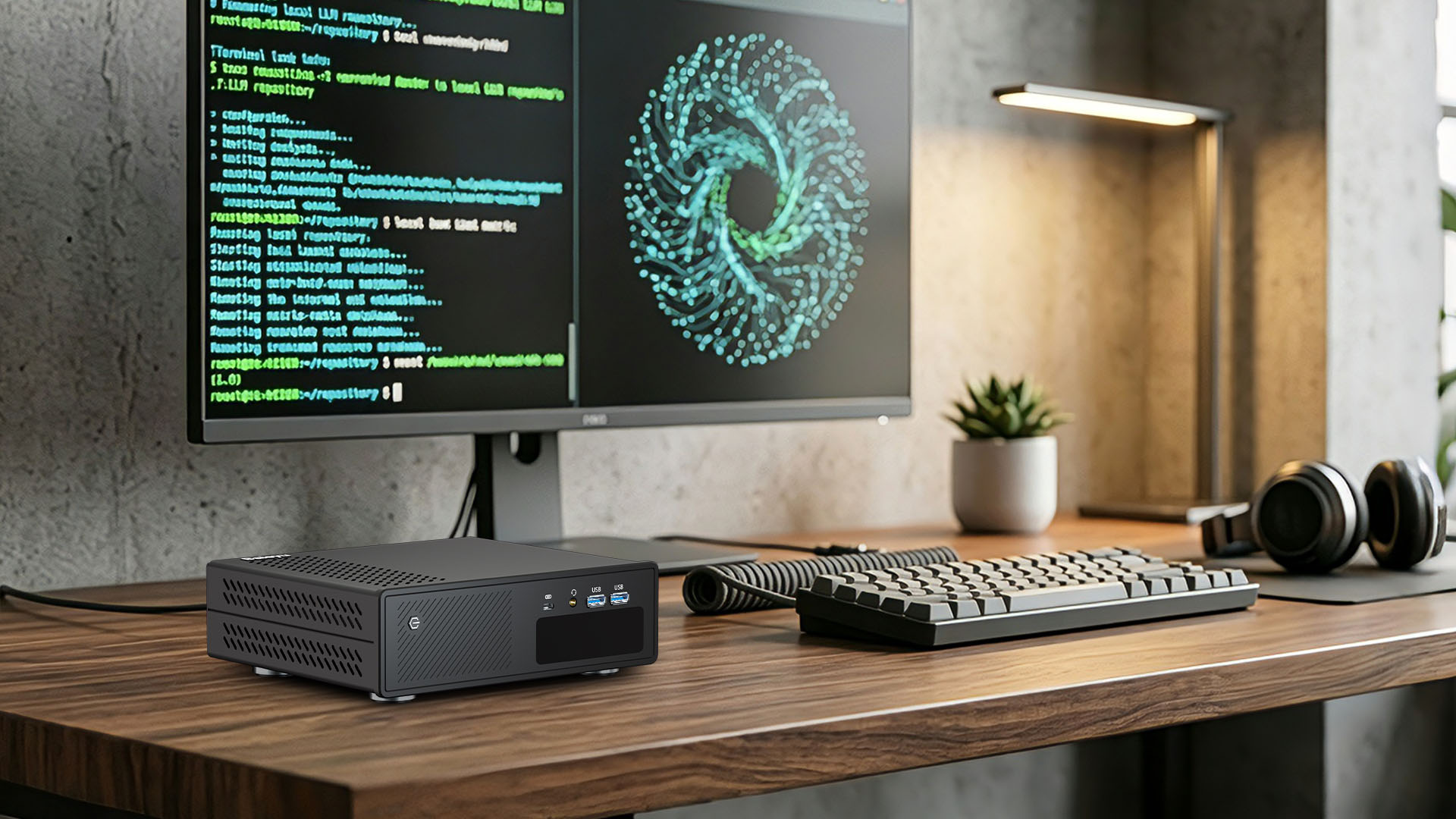
Local AI deployment has become a core demand for both business and home users in 2026. Running large language models (LLMs) directly on a mini PC eliminates data privacy risks, reduces cloud latency, and cuts long-term subscription costs.
However, many buyers fall into the marketing trap of chasing NPU TOPS numbers alone. While the Neural Processing Unit (NPU) handles background tasks efficiently, local LLM execution is heavily constrained by memory bandwidth and CPU/iGPU software stacks. This comprehensive guide breaks down the true architectural requirements for running 7B, 13B, and 34B models locally on a 2026 AI mini PC, helping you invest in the right hardware configuration.
Intel Core Ultra vs. AMD Ryzen AI: The Local AI Architecture Battle
Two processor platforms dominate the 2026 AI mini PC market: Intel Core Ultra (Series 2 “Lunar Lake” / Arrow Lake) and AMD Ryzen AI 300 Series (“Strix Point”). Understanding how their compute and memory architectures interact is vital for AI deployment.
Intel Core Ultra: NPU 4.0 & High-Bandwidth Memory (MoP)
Intel’s 2026 mobile platform shifts the paradigm by introducing Memory-on-Package (MoP) LPDDR5X.
- AI Compute: The NPU 4.0 delivers up to 47 or 48 TOPS, while the integrated Xe2-LPG graphics engine features Intel Xe Matrix Extensions (XMX) for heavier AI loads.
- The Bandwidth Advantage: By integrating LPDDR5X directly onto the CPU package, Intel achieves ultra-high memory bandwidth (up to 136 GB/s at 8533MHz).
- Software Stack: Deeply integrated with OpenVINO, which perfectly splits workloads between the NPU (for low-power context pre-fill) and the iGPU/CPU (for fast token generation) via local runtimes like Ollama.
Limitation: Since MoP RAM is non-upgradable, most Intel AI mini PCs are capped at 32GB or 64GB out of the box.
AMD Ryzen AI: XDNA 2 & High-Capacity Scalability
AMD’s XDNA 2 architecture focuses on high-throughput processing, relying heavily on traditional dual-channel configurations for flexible scalability.
- AI Compute: The standalone XDNA 2 NPU delivers up to 50 TOPS and is designed specifically for low-quantization data handling.
Memory - Architecture: Most AMD-based mini PCs use standard SO-DIMM DDR5 slots (5600 MHz/6400 MHz). While the peak bandwidth is lower than Intel’s board-soldered option (approx. $89.6 GB/s), it allows users to upgrade up to 64GB or 128GB of RAM easily.
- Software Stack: Backed by ONNX Runtime and widening support for ROCm on Linux environments, making AMD mini PCs the preferred choice for open-source AI developers and Linux-based edge systems.
- Limitation: Due to standard DDR5 slot latencies, raw token generation speeds on smaller 7B models lag slightly behind Intel’s LPDDR5X setups.
Hardware Thresholds for Running 7B, 13B, and 34B LLMs Locally
Because LLMs are entirely loaded into volatile memory during inference, your target model size dictates your RAM volume far more than your processor choice.
7B Parameter Models (e.g., Llama 3 8B, Mistral 7B)
Perfect for daily Q&A, email drafting, and personal knowledge base querying.
- Minimum Setup: NPU 20+ TOPS, 16GB RAM, 4-bit quantization (requires ~6GB VRAM/RAM).
- Recommended Setup: NPU 40+ TOPS, 32GB RAM (LPDDR5X preferred), 8-bit quantization.
- The Bottleneck: Virtually any mid-tier 2026 silicon handles 7B models easily. Bandwidth determines if it runs at a human reading speed or a blink-and-miss token rate.
13B Parameter Models (e.g., Qwen 2 14B, Llama 3 13B equivalents)
Tailored for professional document summaries, multi-turn coding assistants, and SMB deployments.
- Minimum Setup: NPU 30+ TOPS, 32GB RAM, 4-bit quantization.
- Recommended Setup: NPU 45+ TOPS, 64GB DDR5 RAM, 8-bit quantization.
- The Bottleneck: Extended context windows (32K+ tokens) exponentially expand the KV cache. If you exceed 32GB RAM, the system will swap data to the SSD, crashing performance. 64GB is highly recommended.
34B to 70B Parameter Models (e.g., Yi 34B, Llama 3 70B highly quantized)
Enterprise-grade reasoning, deep code debugging, and highly accurate agent workflows.
- Minimum Setup: Flagship NPU (50 TOPS), 64GB RAM, 4-bit quantization.
- Recommended Setup: Flagship NPU, 128GB DDR5 RAM, 4-bit or 8-bit execution.
- The Bottleneck: True desktop replacement category. Do not buy integrated LPDDR5X units capped at 32GB for these models. You need raw SO-DIMM expandable capacity.
Real-World Inference Performance & Energy Data
The following benchmarks represent real-world testing conducted via Ollama (v0.5+) using CPU/iGPU-optimized backends in an air-conditioned room (25℃).
Token Generation Speeds (tokens/second)
| LLM Engine Size & Quantization | Intel Core Ultra 7 258V (32GB LPDDR5X @ 8533MHz) | AMD Ryzen AI 9 HX 370 (64GB DDR5 @ 5600MHz) |
| Llama 3 8B (Int4) | 22 t/s (Fluent reading) | 18 t/s (Comfortable) |
| Llama 3 8B (Int8) | 14 t/s | 11 t/s |
| Qwen 2 14B (Int4) | 11 t/s | 9 t/s |
| Yi 34B (Int4) | OOM (Out of Memory) | 4.5 t/s (Analytical speed) |
Notice how the Intel Core Ultra 7 258V outperforms the AMD Ryzen AI 9 on the 8B model despite having fewer peak NPU TOPS. This proves the Memory Bandwidth Paradigm: Local token generation reads the entire weight matrix for every single token. Intel’s 136 GB/s LPDDR5X bus feeds data to the compute units significantly faster than AMD’s 89.6 GB/s DDR5 bus.
Power Consumption During Sustained AI Inference
While a desktop discrete GPU draws anywhere from 150W to 350W during inference, NPU/iGPU-driven mini PCs demonstrate immense power savings:
- Idle / Low-Power Background NPU Tasks: 4W 8W
- Active 8B Model Generation: 15W- 25W total system draw.
- Max sustained 34B Processing: 35W- 54W total system draw.
For 24/7 private local servers, an AI mini PC cuts utility overhead by up to 80% compared to standard AI workstations.
How to Match a Mini PC Configuration to Your AI Needs
Crucial Hardware Trap to Avoid: When buying expandable DDR5 mini PCs, be aware that installing high-capacity dual-rank memory modules can force the memory controller to downclock (e.g., from 5600MHz down to 4800MHz or lower). Always check the manufacturer’s memory compatibility QVL list to ensure you don’t accidentally slash your AI inference speed by $20
- For Creative Professionals & Office Workers (7B-14B Use Cases): Choose an Intel Core Ultra 7 or Ultra 9 system featuring integrated LPDDR5X (32GB or 64GB). The higher bandwidth delivers instantaneous, human-like typing responses for copywriting, scheduling, and local coding.
- For Developers & AI Power Users (14B-34B Use Cases): Opt for an AMD Ryzen AI 9 or high-end Ryzen 7 barebone mini PC. Install 64GB or 128GB of premium dual-channel DDR5 RAM. This ensures the model weights fit comfortably without risking system crashes during massive context token evaluations.
- For Enterprise Edge Deployments: Look for industrial-grade fanless chassis supporting Linux distributions with native ROCm/ONNX runtimes. Prioritize dual M.2 NVMe PCIe 4.0 SSD slots to ensure fast loading times when hot-swapping different model databases.
Breaking the Memory Bottleneck with Dedicated AI Hardware
If you need to deploy 13B to 34B models with faster response times and absolute stability, typical integrated graphics and shared memory bandwidth can become an operational ceiling. For true enterprise-grade workflows and intensive local developer environments, a dedicated GPU workstation is required.
The HYSTOU GT-U AI Mini PC Workstation is specifically engineered to bridge the gap between compact space-saving form factors and heavy local AI workloads.
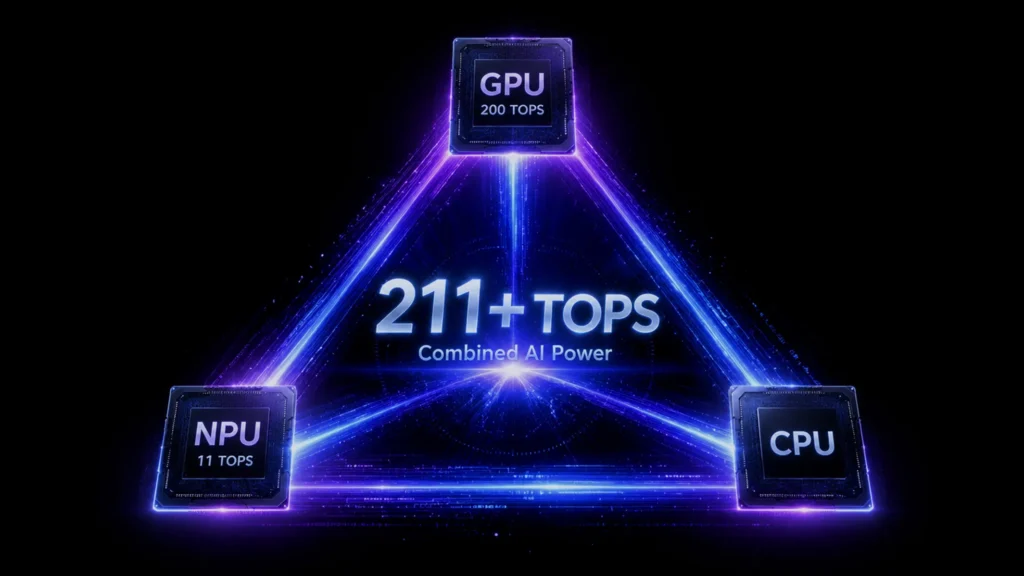
- Massive 211 Total TOPS Boost: Equipped with the latest Intel® Core™ Ultra 7 processor and a discrete NVIDIA® GeForce RTX™ 5050 (Blackwell architecture) GPU, it delivers an aggregate AI compute power of up to 211 TOPS.
- Dedicated VRAM Advantage: Featuring 8GB of ultra-fast dedicated GDDR6 VRAM and supporting DLSS 4, the GT-U offloads local LLM token generation from the system DRAM. This completely bypasses standard DDR5 bandwidth bottlenecks—allowing 13B models to run smoothly at production-grade speeds.
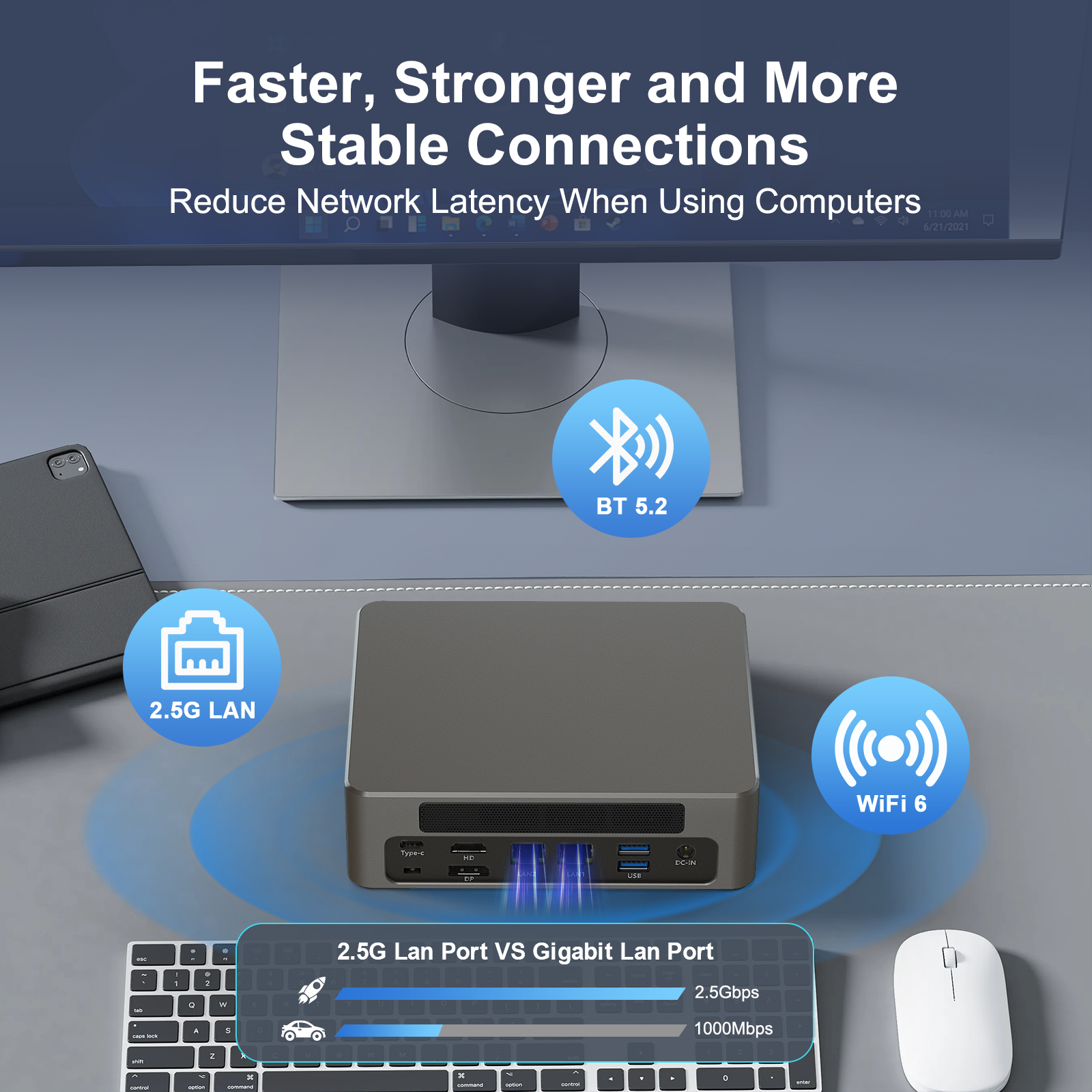
- Future-Proof Edge Deployment: Paired with dual 2.5G LAN ports, next-generation WiFi 7, and a robust triple-fan cooling array, the HYSTOU GT-U acts as a reliable 24/7 private AI node for edge computing, design studios, and secure data synthesis.
Conclusion
The 2026 AI mini PC market brings capable local LLM performance to compact, low-power devices. Understanding that memory bandwidth and dedicated VRAM run the LLM, while NPU TOPS handles efficiency, is the key to making an informed buying decision.
Ready to future-proof your workspace without compromising on performance? Skip the limitations of shared memory and explore the HYSTOU GT-U AI Mini PC Workstation—our premier, dedicated hardware solution engineered specifically to match your high-throughput local AI development roadmap.

Author: Nick FU
Marketing Specialist | HYSTOU Mini PC & Network Appliance Manufacturer
HYSTOU has established its R&D headquarters in Shenzhen, drawing on over a decade of experience. Our core team members, who previously served at renowned companies such as Inventec and Quanta Computer, form the backbone of our technical expertise. With robust R&D and innovation capabilities, we remain steadfast in our commitment to pursuing excellence in the field of technology products.