The Definitive Guide to CAN Bus Integration in Industrial Edge Computing (2026)
As Industry 4.0 transitions into a more mature phase in 2026, the demand for highly reliable, ultra-compact edge computing hardware has skyrocketed. While standard COM ports (RS232/485) remain essential for legacy systems, modern automated guided vehicles (AGVs), robotics, and heavy industrial machinery increasingly rely on a more robust protocol: the CAN Bus (Controller Area Network).
For automation integrators and IT procurement managers, selecting a fanless industrial PC that seamlessly bridges legacy equipment with modern CAN Bus networks—without sacrificing thermal reliability—is a critical challenge. In this comprehensive guide, we will break down the technical integration of CAN Bus, GPIO, and cellular connectivity at the edge, using the Hystou H4T-10th Gen Series as our benchmark.
Why CAN Bus is Essential for Modern Factory Automation
Originally developed for the automotive industry, CAN Bus has become the gold standard for industrial automation due to its high immunity to electrical interference and its ability to allow microcontrollers and devices to communicate with each other’s applications without a host computer.
In a typical smart factory, you might have dozens of sensors, motor controllers, and safety switches communicating simultaneously. A standard PC architecture struggles with this latency and hardware integration. This is where specialized edge nodes step in.
“The integration of physical CAN interfaces directly into the edge computing chassis eliminates the need for unstable third-party USB-to-CAN adapters, significantly reducing points of failure in mission-critical environments.”
Deep Dive: Hystou H4T CAN Bus & GPIO Architecture
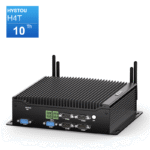
To meet the needs of different scenarios, Hystou provides two chassis designs for the H4T series: a standard version and a dedicated CAN Bus version.
Note: The CAN Bus version is an optional accessory and needs to be purchased for an additional fee during your hardware configuration.
1. Dual CAN Bus Integration (CAN1 & CAN2)
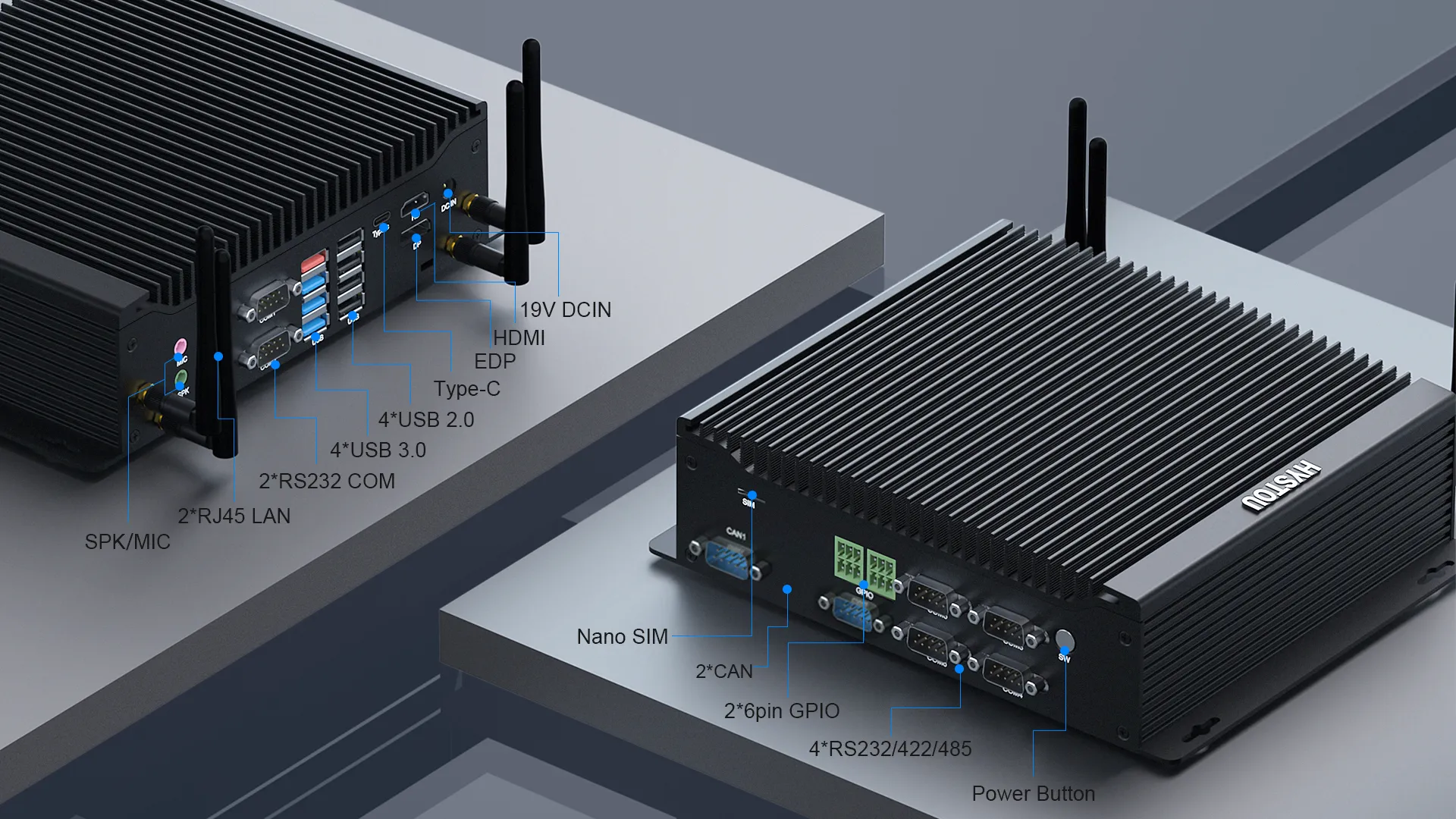
The H4T CAN Bus chassis features dual physical DB9 ports dedicated to CAN1 and CAN2 on the front panel. This dual-channel design allows system integrators to segment network traffic—for example, dedicating CAN1 to critical motor control on an AGV, while CAN2 handles non-critical telemetry data.
2. Programmable GPIO (General-Purpose Input/Output)
Positioned directly next to the CAN ports is the GPIO terminal block. This serves as the common interface for digital signal interaction between the host and industrial peripherals.
Key Function: It supports a programmable input/output mode.
Application: It is perfectly suited for industrial scenarios such as direct sensor signal acquisition, actuator control, and equipment status monitoring without the need for an intermediary PLC.
Remote Edge Connectivity: 4G/5G and Network Redundancy
A true edge computing device must be able to transmit processed data back to the central cloud or local server, even in environments where Wi-Fi or Ethernet is unavailable.
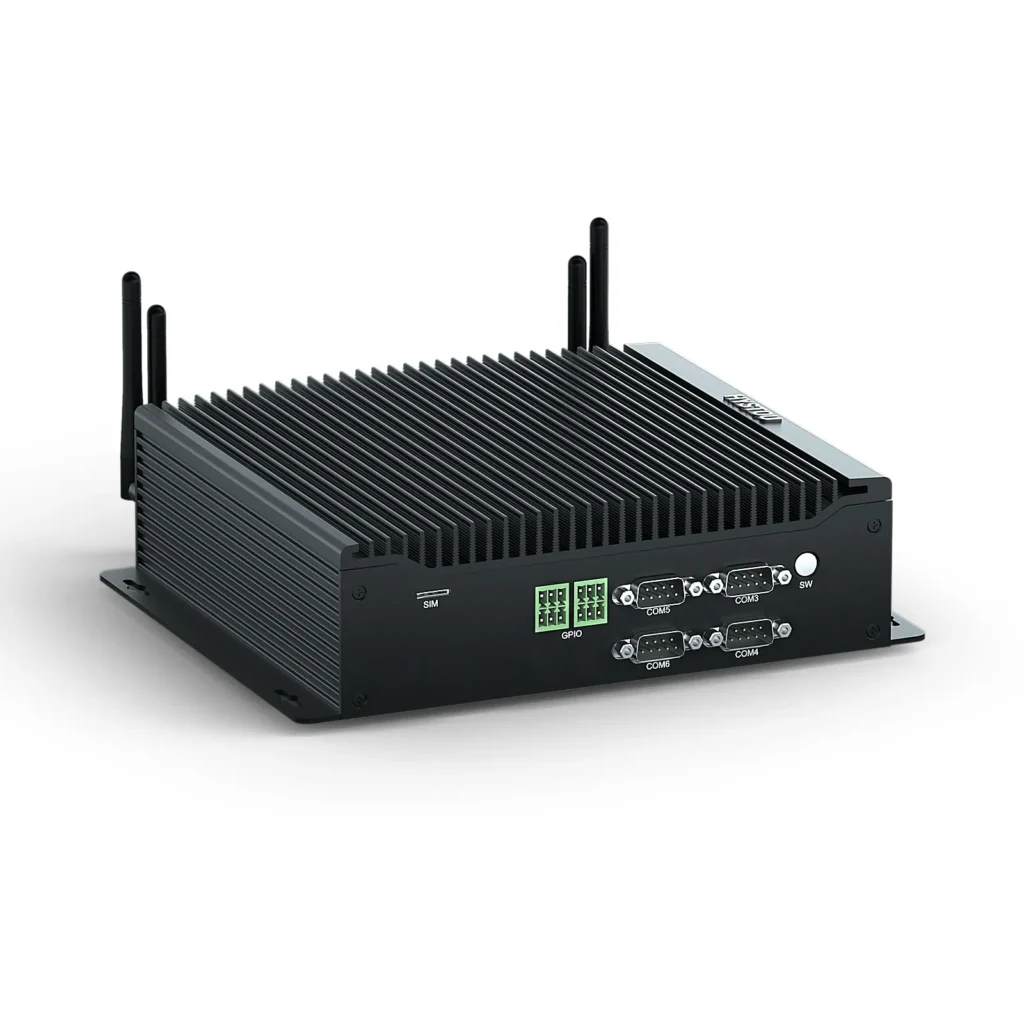
The H4T series features a built-in Nano SIM card slot on the front panel. It mainly connects to mobile networks, allowing the computer to receive 4G or 5G signals and realize wireless Internet access.
Hardware Configuration Requirement:
For the SIM slot to function, it must be paired with a 4G/5G wireless communication module. If the host does not have this module built in, you must install the corresponding module through the motherboard interface (such as the M.2 KEY-B slot) and complete the driver installation. Ensure that the network frequency bands supported by your module match your local operator’s 4G/5G network to avoid incompatibility.
Thermal Reliability: Surviving -20°C to 60°C
Processing power and connectivity are useless if the hardware fails due to overheating or dust accumulation. Active cooling (fans) pulls conductive metal dust into the motherboard, which is unacceptable in CNC or metalworking facilities.
The Hystou H4T utilizes an aluminum alloy chassis cooling system. Aluminum alloy has excellent thermal conductivity and can quickly transmit heat generated by internal components to the chassis surface.
- Passive Cooling: Naturally dissipates heat through air convection, improving operational stability.
- Surface Temperature: The maximum surface temperature of the chassis reaching up to 55°C is completely normal, indicating effective heat discharge.
- Safety: The product design has passed strict temperature control testing; 55°C surface temperature will not affect equipment performance or safety. Ensure the surroundings are well-ventilated.
Use Case: AGV (Automated Guided Vehicle) Deployment
Imagine deploying a fleet of AGVs in a heavy-duty warehouse. By utilizing the Hystou H4T CAN Bus version:
- Motor Control: The AGV’s internal drive system connects directly to the CAN1 port for zero-latency movement commands.
- Collision Avoidance: Proximity sensors are wired into the GPIO block, instantly halting the vehicle if an obstacle is detected.
- Telemetry: The Nano SIM slot equipped with a 5G module streams the vehicle’s battery life and location data to the central warehouse management system in real-time.
- Durability: The fanless aluminum chassis ignores warehouse dust and withstands vehicle vibrations.
Frequently Asked Questions (FAQ) for Integrators
Q1: Does the H4T come with CAN Bus by default?
A: No. To meet different scenario needs, the H4T offers a standard version and a CAN Bus version. The CAN Bus version is an optional accessory and must be purchased for an additional fee. Please communicate your specific requirements to our sales team.
Q2: Can I hot-plug displays into the DP or HDMI ports?
A: To ensure stability, please keep the host power off when connecting or disconnecting devices to the DisplayPort. It features a non-hot plug-in design.
Q3: Are the dual LAN ports gigabit?
A: Yes. The RJ45 Ethernet ports support data transmission rates up to 1 Gbps and are backward compatible with 100 Mbps and 10 Mbps.
Q4: How do I reset the CMOS if a BIOS configuration causes a boot failure?
A: In the power outage state, use metal shorting on the JCMOS needle mount for 5 seconds to restore the CMOS parameters to their default state.
Ready to Upgrade Your Industrial Infrastructure?
Choosing the right edge hardware defines the success of your automation projects. The Hystou H4T-10th Gen series provides the perfect balance of legacy COM support, modern CAN Bus integration, and unbreakable fanless reliability.

HYSTOU
HYSTOU has established its R&D headquarters in Shenzhen, drawing on over a decade of experience. Our core team members, who previously served at renowned companies such as Inventec and Quanta Computer, form the backbone of our technical expertise. With robust R&D and innovation capabilities, we remain steadfast in our commitment to pursuing excellence in the field of technology products.