

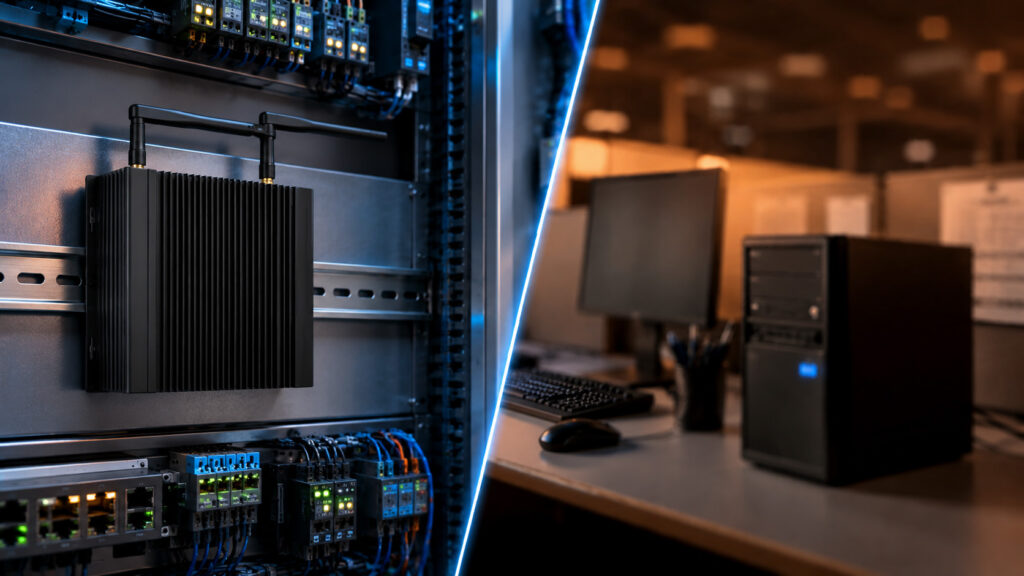
What Is an Embedded PC? Differences Between Industrial and Desktop Computers
What Is an Embedded PC? Differences Between Industrial and Desktop Computers Announcements Buyer Guide Comprehensive Tips Occasion Product Review Q&A Tutorials Embedded PCs power countless devices and systems around us, from factory automation lines to digital menu boards. Yet many people confuse embedded industrial PCs with regular desktop computers.Both types of computing hardware serve calculation and data processing needs, but they differ greatly in design, durability, and use cases.This guide explains what an embedded PC is, breaks down the key differences between industrial and desktop computers, and helps you pick the right solution for your project. What Exactly Is an Embedded PC? An embedded PC is a dedicated computing system built into a larger device or infrastructure.Unlike general-purpose computers, it performs one or a few specific pre-defined tasks.Most embedded PCs feature a compact form factor, low power consumption and high stability.They often operate 24/7 for years without manual maintenance.In many cases, industrial embedded PCs adopt fanless designs to resist dust, moisture and vibration.They also support wide operating temperature ranges to work in extreme environments.Unlike a standard desktop that sits on a desk, an embedded PC usually stays hidden inside equipment, cabinets or vehicles. Industrial Embedded PC vs. Desktop Computer: Core Differences To understand the gap between industrial embedded PCs and consumer desktops, we compare them across 8 key dimensions. Dimension Industrial Embedded PC Desktop Computer Core Purpose Built for specific industrial/embedded tasks Built for general daily use (office, entertainment, gaming) Environmental Tolerance Wide temperature range (-20°C to 60°C common); dustproof, shockproof, vibration-resistant Standard room temperature (10°C to 35°C); sensitive to dust and vibration Service Life 5–10 years long product lifecycle; stable component supply 2–3 years typical lifecycle; frequent hardware updates Cooling System Mostly fanless passive cooling Active fan cooling as standard Performance Focus Stable, sustained performance for long runtime Peak burst performance for short-term heavy load Reliability 24/7 continuous operation supported Designed for 8–10 hours of daily use I/O Interfaces Rich industrial ports (CAN bus, RS232/485, GPIO, dual LAN) Standard consumer ports (USB, HDMI, audio) Total Cost of Ownership Higher upfront cost, lower long-term maintenance cost Lower upfront cost, higher failure and replacement cost On the surface, a desktop PC may offer higher specs at a lower price.However, it fails to deliver the reliability required for industrial and embedded scenarios.Next, we look deeper at why industrial embedded PCs are the safer choice for mission-critical projects. Industrial Embedded PCs: Engineered for Harsh Conditions Industrial embedded PCs are purpose-built for environments where standard desktops cannot survive. They address three major pain points of consumer hardware in industrial settings.First, extreme temperature fluctuations. Factories, outdoor cabinets and vehicle cabins often see temperatures well beyond room comfort levels. A fanless embedded industrial PC uses a sealed chassis and an aluminum heat dissipation structure.It maintains stable operation even in -20°C to 60°C environments.Second, dust, moisture and vibration. Open-fan desktops suck in dust and suffer from loose parts under constant vibration. Industrial embedded PCs adopt fully enclosed designs and solid-state storage. They resist dust ingress, humidity impact and mechanical shock effectively.Third, long-term uninterrupted operation.Production lines, monitoring systems and edge computing nodes run around the clock. Industrial PCs use industrial-grade chipsets and components with longer MTBF (Mean Time Between Failures). They also include watchdog timers and power failure protection to reduce downtime risks.For example, HYSTOU industrial mini PCs follow strict embedded design standards.They feature fanless cooling, wide temperature support and rich industrial I/O options.Many models support DIN rail mounting and embedded integration, fitting perfectly into automation cabinets and equipment. Where Are Embedded PCs Most Commonly Used? Embedded PCs appear in a wide range of industries and scenarios. Here are the most typical use cases. Industrial automation: Control PLC systems, data acquisition and production line monitoring Intelligent transportation: In-vehicle computing, fleet management and traffic signal control Digital signage: Retail menu boards, advertising displays and information kiosks Security surveillance: NVR systems, edge AI analytics and access control terminals Edge computing: On-site data processing for IoT devices and smart factories Medical equipment: Diagnostic devices, patient monitoring and laboratory instrumentation For each scenario, reliability and environmental adaptability always come before raw performance. That is why embedded industrial PCs remain the first choice for professional deployments. Why Choose a HYSTOU Embedded Mini PC for Your Project? HYSTOU specializes in designing and manufacturing embedded and industrial mini PCs. Our products balance compact size, stable performance and industrial-grade durability.Here are the core advantages of choosing a HYSTOU embedded mini PC. 1. Fanless sealed design All our industrial embedded models use passive cooling with aluminum alloy housings. This eliminates fan noise and prevents dust and moisture from entering the system. It also reduces mechanical failure points for longer service life. 2. Wide temperature and voltage support Most HYSTOU industrial mini PCs operate stably from -10°C to 55°C, with some extended models reaching -20°C to 60°C. They also support wide voltage input (9–36V DC) to adapt to unstable power environments. 3. Rich industrial connectivity Our embedded PCs come with multiple LAN ports, COM ports (RS232/485), GPIO and optional CAN bus modules. They can connect directly to sensors, controllers and other industrial equipment without extra adapters. 4. Flexible mounting options HYSTOU mini PCs support VESA mounting, DIN rail mounting and embedded installation. They fit behind displays, inside control cabinets or inside custom equipment easily. FAQ Is an embedded PC the same as an industrial PC? Not exactly. An embedded PC refers to a computer integrated into a larger system for dedicated tasks. An industrial PC refers to a computer built for industrial environments. Most industrial PCs are used in embedded scenarios, so the terms often overlap. But not every embedded PC is industrial-grade — some consumer embedded devices only work in normal environments. Can I use a regular desktop PC for industrial applications? You can try, but it is not recommended for long-term or mission-critical use. Desktop PCs lack temperature tolerance, dust resistance and 24/7 stability. They are much more likely to fail in harsh industrial settings. A sudden breakdown can cause production downtime and higher economic
What Is an Embedded PC? Differences Between Industrial and Desktop Computers Read More »