Hsytou H6 Fan vs Fanless Comparison: Which Industrial Mini PC Suits You?
Introduction: The Cooling Dilemma in Industrial Computing
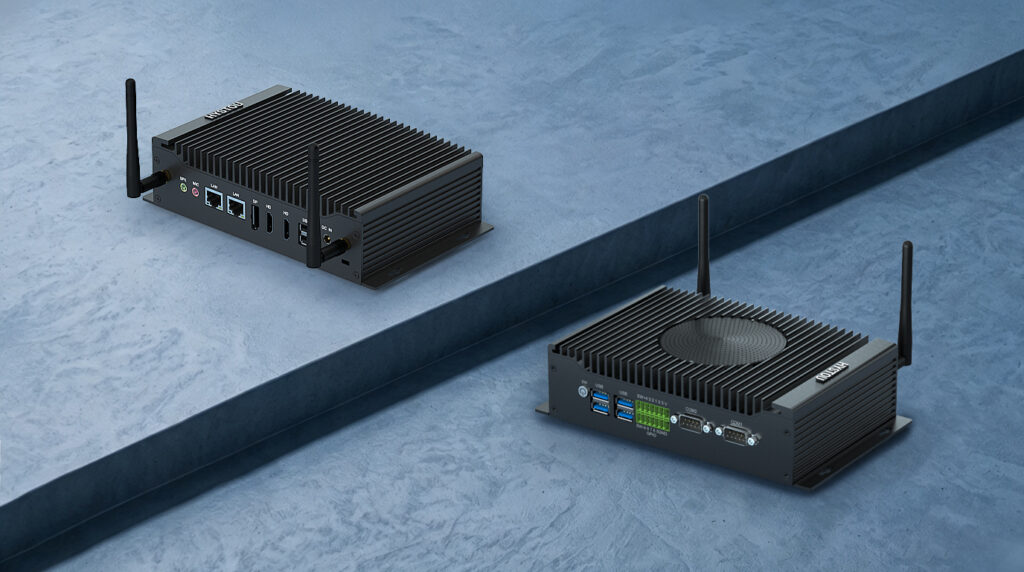
In industrial automation and edge computing, selecting between active fan cooling and passive fanless thermal design impacts operational longevity, maintenance frequency, and sustained processing performance. The Hystou H6 Industrial Mini PC series addresses this challenge by offering two tailored cooling architectures within the same compact 205 × 125 × 53 mm aluminum chassis.
Whether you are deploying automated control systems, edge IoT gateways, or machine vision processing, understanding the real-world performance trade-offs between the fan-cooled and fanless Hystou H6 models is essential for optimizing your hardware investment.
At a Glance: Quick Recommendation
Choose the Fan-Cooled Hystou H6 if your application demands continuous high CPU utilization, sustained multi-core workloads, or machine vision processing where active heat dissipation prevents thermal throttling.
Choose the Fanless Hystou H6 if your deployment environment is dust-heavy, requires absolute zero acoustic noise, or demands a 24/7 zero-maintenance footprint in remote or sealed enclosures.
Specification & Performance Comparison
The table below summarizes the key technical specifications, real-world benchmark metrics, and thermal stress test results between both Hystou H6 configurations:
| Feature / Metric | Fan-Cooled Hystou H6 | Fanless Hystou H6 |
| Cooling Architecture | Active (Internal Fan + Dust Net Filter) | Passive (Extrusive Aluminum Heat Sink Chassis) |
| Dimensions | 205 × 125 × 53 mm | 205 × 125 × 53 mm |
| Processor Options | Intel Core i5-8260U / up to Core i7-10810U | Intel Core i5-8260U / up to Core i7-10810U |
| Geekbench Single-Core | 1,179 | 1,115 |
| Geekbench Multi-Core | 4,606 | 3,051 |
| 3DMark FPS / Score | 12.5 FPS / 315 | 10.6 FPS / 267 |
| Peak CPU Temp (AIDA64 Load) | ~70°C (Stable) | ~86°C (Thermal Throttling) |
| Chassis Surface Temp | ~40°C | ~53.9°C |
| Power Consumption (Full Load) | ~16.9 W | ~14.9 W |
| Acoustic Output (Full Load) | 30–40 dB(A) | 0 dB(A) (Absolute Silence) |
| Maintenance Profile | Periodic Dust Net Cleaning | Zero Moving Parts / Zero Maintenance |
Design and Build: Active vs. Passive Thermal Engineering
The Fan-Cooled Hystou H6: Active Heat Dissipation
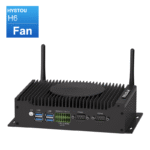
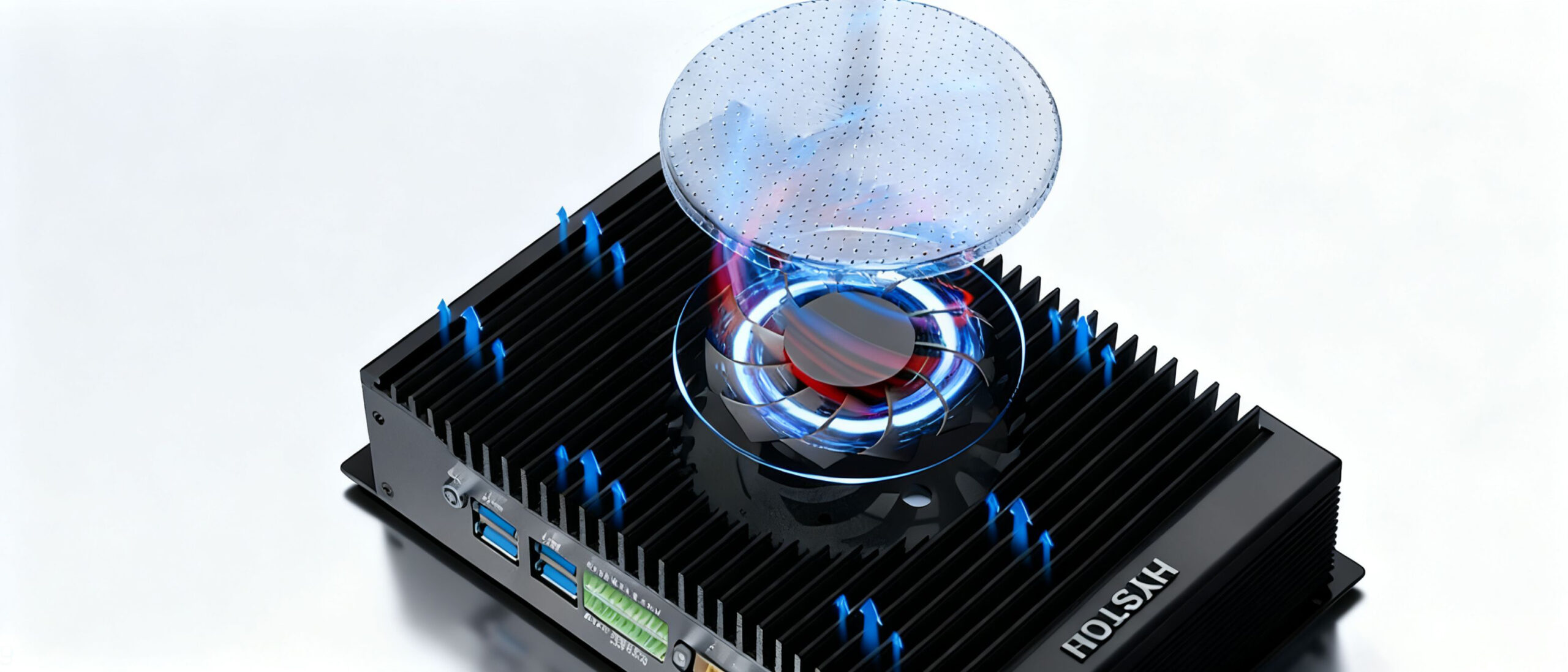
The fan-cooled Hystou H6 utilizes an active thermal management system engineered for high-density compute tasks. Measuring 205 × 125 × 53 mm, the precision CNC-machined aluminum chassis integrates a dedicated cooling fan positioned directly above the CPU socket to drive forced air induction.
To counteract particle ingress in harsh industrial environments, Hystou incorporates an integrated dust filter over the air intake. This protective barrier prevents debris build-up on internal circuitry, reducing thermal degradation and safeguarding hardware longevity while the aluminum shell acts as a secondary heatsink.
The Fanless Hystou H6: Sealed Passive Cooling
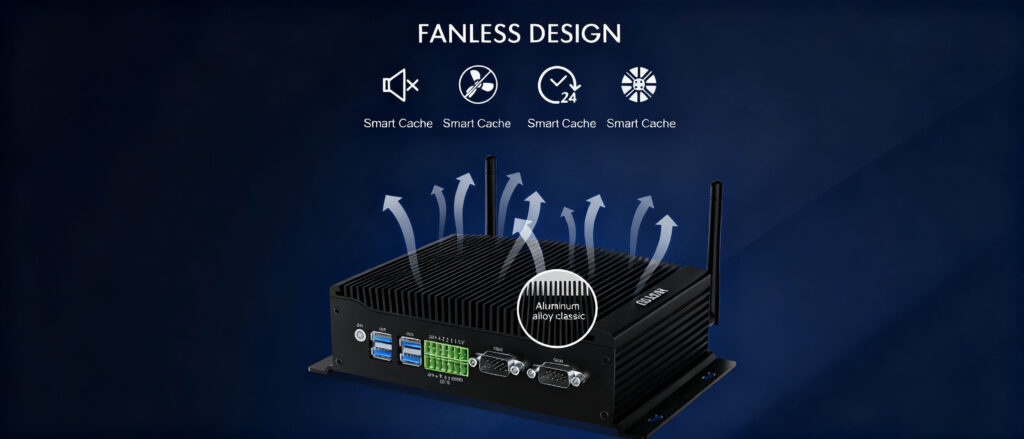
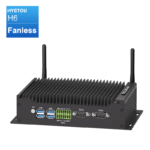
The fanless Hystou H6 removes all moving mechanical components in favor of passive convection cooling. Retaining the same 205 × 125 × 53 mm footprint, its chassis features extruded thermal fins along the top and side panels, dramatically increasing total surface area for passive radiation.
By eliminating the fan, the fanless model achieves complete mechanical immunity to fan wear, bearing failure, and air-recirculation dust accumulation. This fully silent, dust-resistant enclosure makes it ideal for deployment in air-quality-sensitive production zones or remote control cabinets.
Technical Specifications & Industrial I/O Capabilities
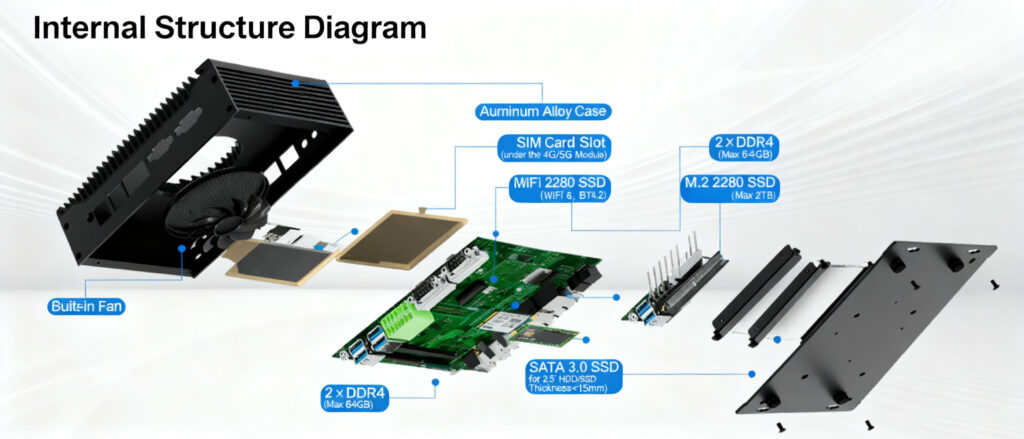
Both Hystou H6 variants share a robust hardware foundation designed for industrial control and legacy device integration:
Compute & Memory: Powered by an Intel Core i5-8260U processor (4 cores / 8 threads, 1.60 GHz base up to 3.90 GHz Turbo Boost) or optionally up to an Intel Core i7-10810U. Dual DDR4 SO-DIMM slots support up to 64 GB of memory.
Storage Flexibility: Equipped with 1 × M.2 2280 slot for high-speed NVMe/SATA SSDs alongside 1 × 2.5-inch SATA 3.0 internal bay for data logging drives.
Display Output: Supports triple-display configurations via 1 × DisplayPort and 2 × HDMI ports, enabling multi-monitor HMI visualization setup.
Industrial Interfaces: Features 2 × RS232 COM ports (configurable to RS422/RS485 via optional adapters) and 1 × 14-pin GPIO Phoenix terminal for direct sensor, relay, and PLC integration.
Connectivity & Networking: Dual Ethernet network interface controller ports support high-speed local networks and industrial protocols, complemented by standard 4 × USB 3.0, 2 × USB 2.0, onboard 802.11ac Wi-Fi, and Bluetooth modules.
Benchmark & Stress Test Performance Analysis
CPU & Multi-Threaded Workloads
Synthetic tests using Geekbench Browser illustrate how thermal headroom impacts compute throughput:
Single-Core Operations: The fan-cooled model scored 1,179, while the fanless model reached 1,115. For bursty, single-threaded processing and light HMI feedback, both configurations offer near-identical responsiveness.
Multi-Core Operations: Under sustained multi-threaded execution, the active cooling variant scored 4,606 versus 3,051 on the fanless system. Active airflow enables the CPU to maintain elevated Turbo Boost clock speeds across all cores without thermal limitations.
Thermal Behavior Under Sustained Load
A 60-minute stress test utilizing AIDA64 revealed distinct operational characteristics:
Fan-Cooled Model: Stabilized at an internal CPU temperature of ~70°C under full load, drawing an average of 16.9 W. System performance remained constant with zero thermal throttling, while outer chassis temperatures stayed at a cool 40°C.
Fanless Model: Internal CPU temperatures reached ~86°C under sustained load, consuming 14.9 W. To prevent damage, the system executed controlled frequency throttling, reducing long-term throughput by approximately 30%. The external aluminum body reached 53.9°C as it dissipated internal heat outward.
Operational Noise & Acoustic Performance
Anechoic chamber measurements quantify the acoustic profiles of both thermal architectures across operational states:
Idle State: The fan-cooled variant registers at an imperceptible 22 dB(A), while the fanless configuration sits at ambient background level (18 dB(A)).
Full Load State: Under maximum CPU load, the fan-cooled model reaches 30–40 dB(A)—equivalent to a quiet office or soft conversation. The fanless model maintains 0 dB(A) noise emission across all operating conditions.
Application Scenarios: Matching the Right Model
Deploy the Fan-Cooled Hystou H6 for:
- Machine Vision & Image Processing: Real-time 1080p frame decoding and inspection algorithms that require continuous, non-throttled multi-core compute power.
- Complex PLC & Supervisory Control (SCADA): High-density I/O polling, rapid data processing, and complex simulation loops that demand maximum CPU clock stability.
- Multi-Display Control Rooms: Driving triple-monitor video feeds and intensive graphic interfaces concurrently.
Deploy the Fanless Hystou H6 for:
High-Dust & Harsh Environments: Textile plants, woodworking shops, and flour mills where airborne particulate matter quickly clogs fans and heat sinks.
Unattended & Remote IoT Gateways: Outdoor solar cabinets, traffic signal boxes, and remote environmental monitoring stations where mechanical fan failures could cause expensive service calls.
Cleanrooms & Noise-Sensitive Spaces: Precision laboratories, medical facilities, and clean manufacturing environments requiring zero air disturbance and 100% silent operation.
Conclusion
Both configurations of the Hystou H6 Industrial Mini PC deliver versatile connectivity, legacy serial interface support, and solid structural reliability.
Your choice rests on the operating environment and compute profile: select the fan-cooled model when sustained CPU performance and lower internal temperatures take priority, or opt for the fanless model when complete dust protection, zero acoustic output, and maintenance-free operation are paramount.

HYSTOU
HYSTOU has established its R&D headquarters in Shenzhen, drawing on over a decade of experience. Our core team members, who previously served at renowned companies such as Inventec and Quanta Computer, form the backbone of our technical expertise. With robust R&D and innovation capabilities, we remain steadfast in our commitment to pursuing excellence in the field of technology products.