Fanless Industrial PC: Why It’s the Standard for Harsh Environments
In harsh industrial environments, traditional desktop computers often fail within a short period of time. This is mainly due to dust, vibration, and extreme temperatures.
However, a fanless industrial PC is specifically designed to handle these challenges. As a result, it has become the preferred solution in industries such as manufacturing, automation, and edge computing.
In this article, we will explore why fanless systems are so reliable and how HYSTOU industrial mini PCs stand out in real-world applications.
Why Fanless Industrial PCs Are Widely Used
1. Dustproof Design for Harsh Environments
In many factories, including textile and machining environments, dust and oil particles are everywhere. Traditional computers rely on cooling fans, which pull air—and contaminants—into the system.
As a result, dust accumulates quickly and causes overheating or even hardware failure.
In contrast, a fanless industrial PC uses a sealed enclosure and passive cooling. Therefore, it effectively prevents dust intrusion and ensures long-term stability.
2. Stronger Anti-Vibration Capability
Industrial environments often involve constant vibration, especially near heavy machinery or AGV systems.
Because traditional fans contain moving parts, they are more likely to wear out or fail under such conditions.
On the other hand, fanless systems eliminate mechanical components. In addition, they usually use SSD storage instead of HDDs. As a result, they offer significantly higher durability and reliability.
3. Reliable 24/7 Operation
Most industrial applications require systems to run continuously without interruption.
However, fan-based cooling systems tend to fail over time due to mechanical wear.
For this reason, fanless industrial PCs are designed for 24/7 operation. Moreover, they feature higher MTBF (Mean Time Between Failures), which ensures long-term stability.
4. Lower Maintenance and Noise
Another key advantage is reduced maintenance.
Since there are no fans to clean or replace, maintenance costs are significantly lower. In addition, fanless systems operate silently, which improves overall working conditions.
Core Technologies Behind Fanless PCs
Not every computer can operate without a fan. In fact, fanless systems require advanced thermal and hardware design.
First, they use low-power processors to reduce heat generation.
Second, they rely on a full aluminum chassis for efficient heat dissipation.
Finally, they support wide voltage input and wide temperature ranges.
As a result, these systems can operate reliably in extreme environments.
Why HYSTOU Industrial Mini PCs Stand Out
Rugged Industrial Design
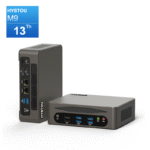
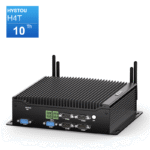
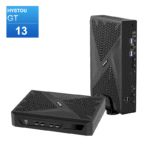
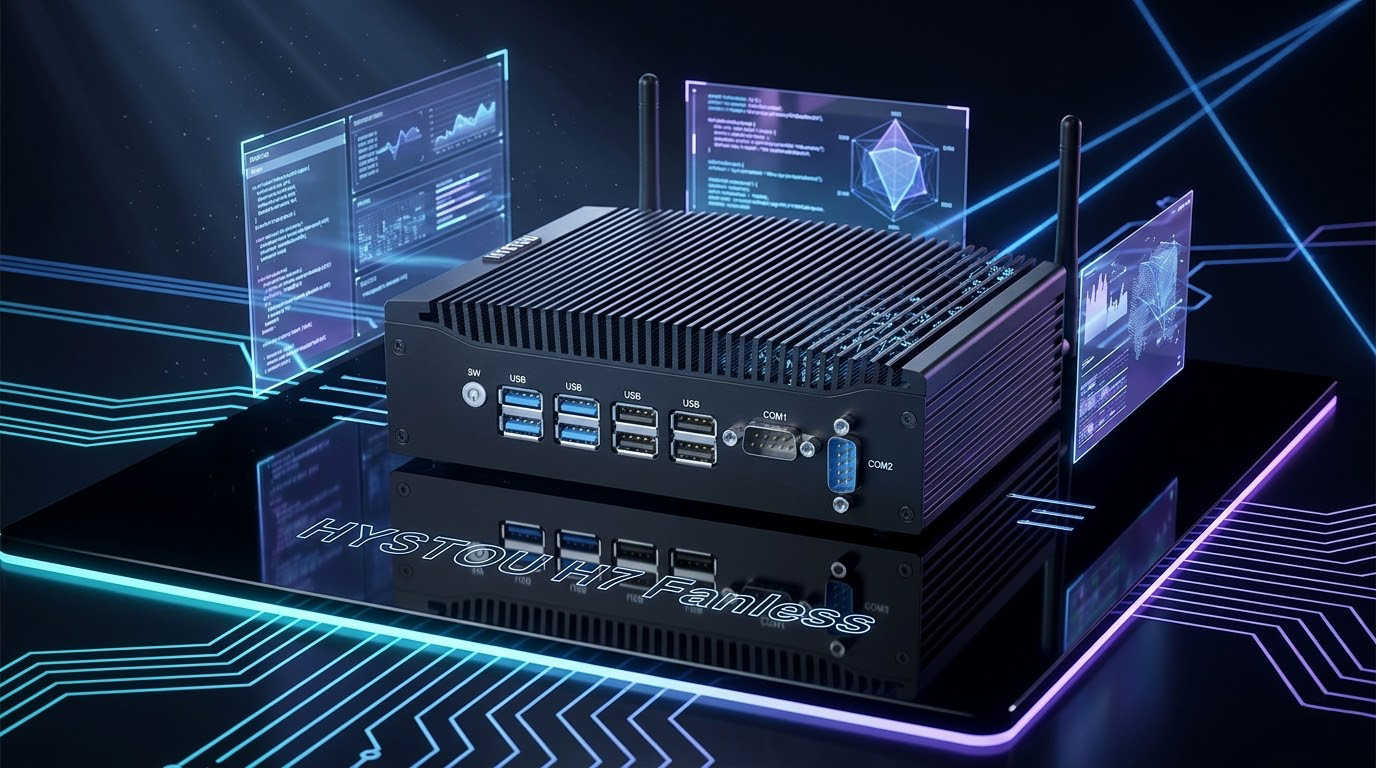
HYSTOU industrial mini PCs feature CNC-machined aluminum enclosures. Therefore, they provide excellent heat dissipation and EMI protection.
In addition, these systems are designed to withstand harsh environments, including vibration and dust.
High Performance Meets Flexibility
Many people assume that fanless systems offer low performance. However, this is no longer true.
HYSTOU supports modern Intel processors, high-speed memory, and fast SSD storage. As a result, these systems can handle demanding tasks such as automation and edge computing.
Moreover, they provide multiple COM ports and LAN ports. Therefore, they are fully compatible with industrial equipment and legacy systems.
Smart Hybrid Cooling Design
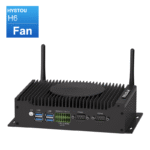
Some HYSTOU models feature a hybrid cooling system.
Under normal conditions, passive cooling is sufficient. However, when the system is under heavy load, a smart fan may activate.
As a result, the system maintains both performance and reliability without sacrificing noise control.
Long Lifecycle and Security
Industrial users require long-term stability.
For this reason, HYSTOU systems are designed with a long lifecycle and high reliability. In addition, they support TPM 2.0 for enhanced data security.
Typical Applications of Fanless Industrial PCs
Fanless industrial PCs are widely used across various industries.
For example, they are used in smart manufacturing to control automation systems.
In addition, they power digital signage and self-service kiosks.
Meanwhile, they are also deployed in edge computing scenarios for real-time data processing.
Conclusion
In summary, a fanless industrial PC is not just a hardware choice—it is a reliable solution for harsh environments.
Because of its dustproof design, anti-vibration capability, and 24/7 stability, it has become the industry standard.
If you are looking for a durable and high-performance solution, HYSTOU industrial mini PCs offer an ideal balance of reliability, flexibility, and performance.

HYSTOU
HYSTOU has established its R&D headquarters in Shenzhen, drawing on over a decade of experience. Our core team members, who previously served at renowned companies such as Inventec and Quanta Computer, form the backbone of our technical expertise. With robust R&D and innovation capabilities, we remain steadfast in our commitment to pursuing excellence in the field of technology products.