Why the PC Era Is Declining & Mini PCs Are Rising
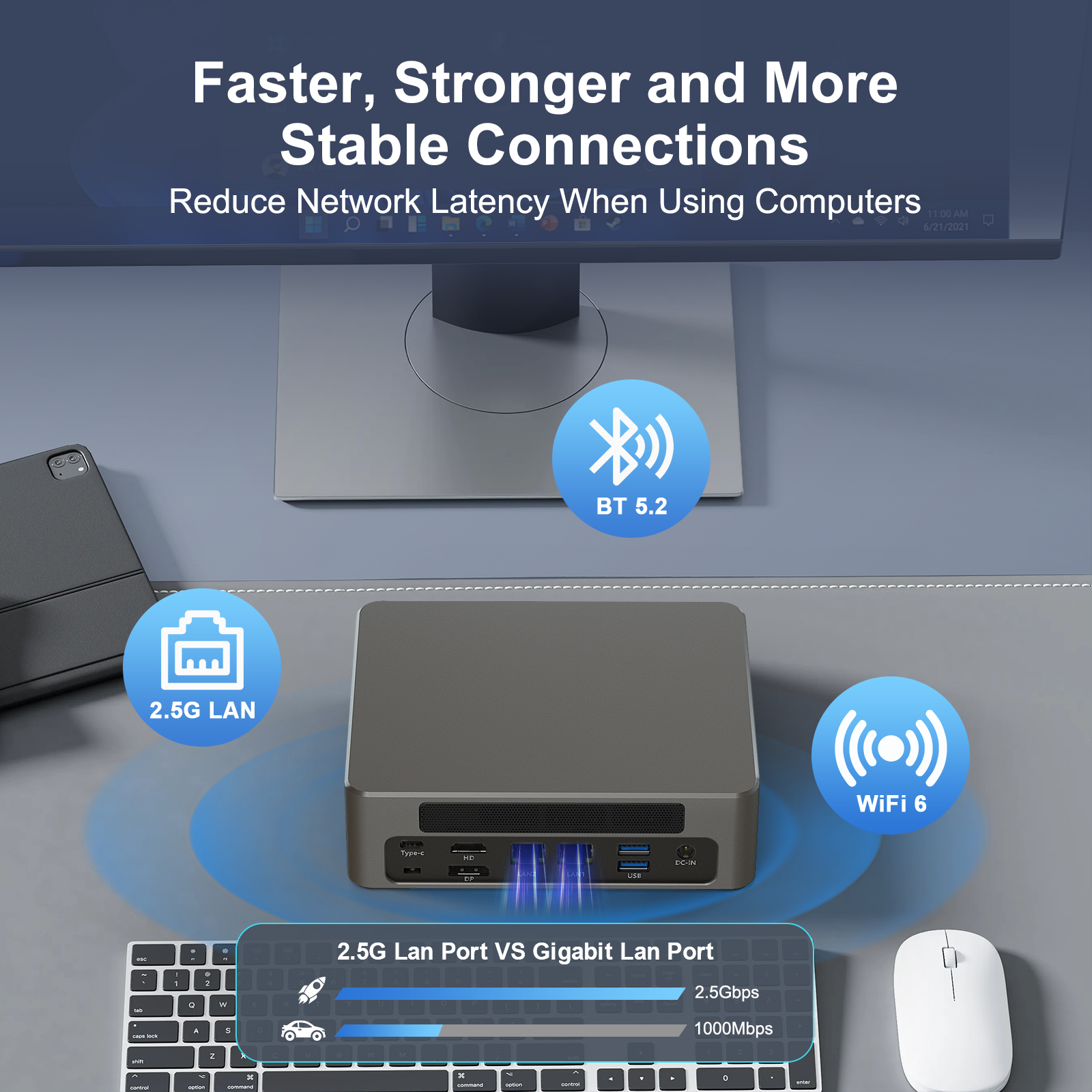
In Q1 2025, global PC shipments dropped 12.3% year-over-year, marking the fifth consecutive year of decline. Meanwhile, the mini PC category soared by 47% YoY, emerging as the brightest growth driver in consumer electronics. This contrasting market landscape is reshaping the trajectory of computing devices worldwide.
According to IDC’s “2025 Global Client Device Market Report,” mini PCs achieved a 38.6% compound annual growth rate (CAGR) over the past three years, while traditional desktops and laptops posted -8.2% and -5.7% respectively. Notably, in the enterprise segment, mini PC penetration surged from 11% in 2022 to 34% in 2025, projected to exceed 40% next year.
How Mini PCs Solve Modern Users’ Top 3 Pain Points
Global research with 5,000 users across 12 key markets reveals that space efficiency, energy consumption, and performance redundancy are the top three factors influencing device upgrades—areas where mini PCs excel.
Space Revolution: Compact Computing 40% Smaller Than Mac Mini
A multinational advertising firm’s office renovation project showed that deploying 500 mini PCs boosted space utilization by 27% and increased employee satisfaction with the work environment by 18 percentage points.
Energy Efficiency: Save a Laptop’s Annual Electricity Cost
Device Type | Typical Power Consumption | Annual Electricity Use (8hrs/day) | Annual Electricity Cost (USD 0.08/kWh)* |
Traditional Desktop | 250W | 365 kWh | $29.20 |
Mid-Range Laptop | 65W | 94.9 kWh | $7.59 |
High-End Mini PC | 35W | 51.1 kWh | $4.09 |
Entry-Level Mini PC | 15W | 21.9 kWh | $1.75 |
For enterprises with a 3-year device replacement cycle, 10,000 mini PCs save approximately $75,400 in electricity costs compared to traditional desktops, equivalent to reducing 3,860 tons of carbon emissions. This aligns with global enterprises’ ESG strategies while cutting operational costs.
Precision Performance: A Smart Choice Beyond "Overkill"
Technological Breakthroughs & Scene Reconstruction Behind Mini PC Growth
The mini PC boom stems from semiconductor advancements and shifting user scenarios. Over five years, process technology has advanced from 14nm to 3nm, and SoC integration has increased 300%, enabling “small size, strong performance.” Meanwhile, cloud service popularity and edge computing growth have made local computing needs “lighter and more specialized.”
Paradigm Shift: From "All-in-One" to "Scene-Specific"
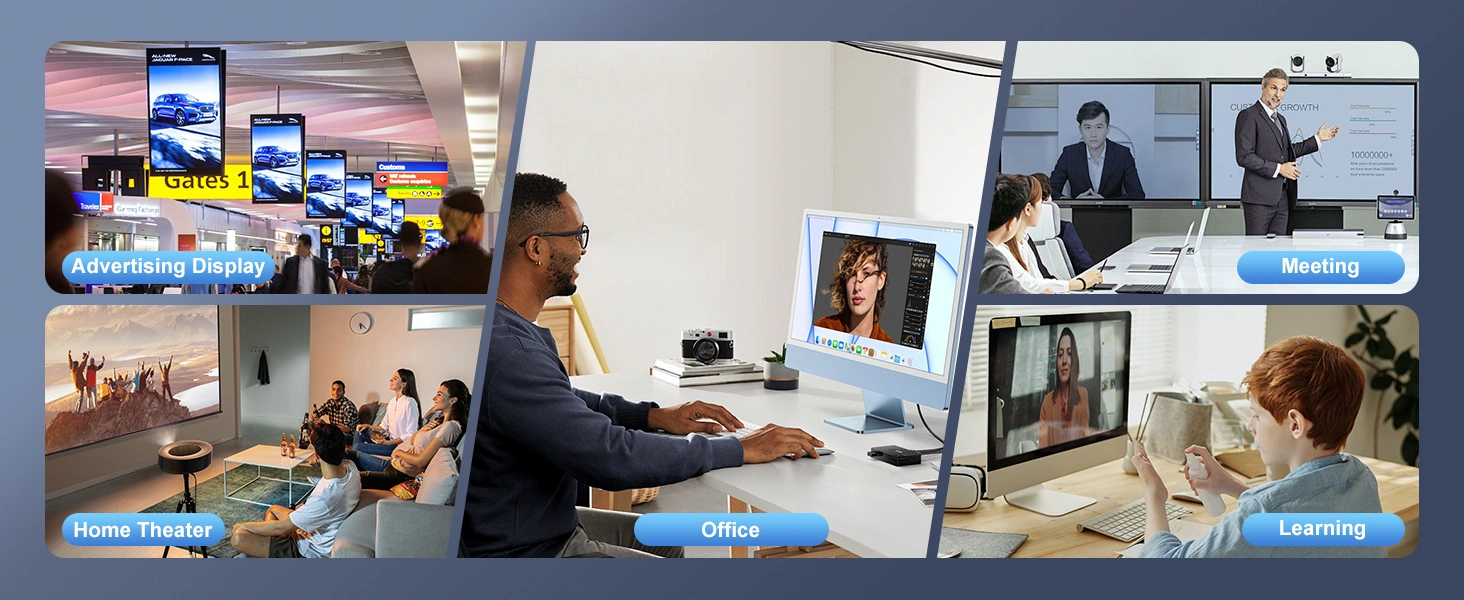
Traditional PCs aim to meet all user needs, leading to the contradiction of “performance overkill” and “functional insufficiency.” Mini PCs adopt a differentiated strategy: office-focused models prioritize stability and multitasking; home entertainment variants enhance video decoding and graphics; industrial devices emphasize expansion ports and environmental adaptability.
E-commerce data shows that searches for “office-specific” mini PCs rose 210% in 2024, while “living room host” sales increased 156% YoY—accelerating market maturity through scene segmentation.
Ecosystem Improvement Breaks Final Barriers
Early peripheral compatibility issues have been resolved. USB4’s popularity enables single-cable transmission of video, data, and power, while Wi-Fi 7 and Bluetooth 5.3 ensure stable wireless connections. Windows 11 and Linux have launched mini PC-optimized versions, addressing driver adaptation and performance release challenges.
3 Key Mini PC Trends to Watch in 2025
The mini PC market is evolving rapidly, with technological innovation and scene expansion driving upgrades. Three trends stand out:
Modular Design: Upgrade Without Replacing the Entire Device
Next-gen mini PCs will adopt modular designs, allowing users to upgrade RAM, storage, or even processor modules individually. This extends device lifespan from 3-4 years to 6-8 years and reduces hardware upgrade costs by over 60%.
Computing Power at the Edge: Ideal for Edge Computing
With 5G and IoT proliferation, edge computing demand is exploding. Mini PCs—small, low-power, and high-performance—are ideal edge nodes. Deployments in smart retail, industrial IoT, and healthcare grew 189% in 2024.
AI Integration: From "Functional" to "Intelligent"
Mini PCs will universally integrate NPU units for local AI computing. This enables offline operation of voice assistants, image recognition, and natural language processing—boosting response speeds by over 80% while protecting user privacy.
How to Choose the Right Mini PC for You For Office Users: Balanced Performance
For document editing, web browsing, and video conferencing, opt for models with Intel Core i5-N305 or AMD Ryzen 5 7535U processors, 16GB+ RAM, and 512GB NVMe SSD. These configurations run Office, Zoom, and light image editing smoothly, priced between $350-$560.
For Home Entertainment: Prioritize Graphics & Ports
For 4K video playback, game streaming, and home theater systems, choose AMD platforms with Radeon 680M iGPU (e.g., Ryzen 7 7840HS). HDMI 2.1 and SPDIF optical outputs are essential for connecting high-end TVs and audio systems. Hystou’s HM80 series starts at $460.
For Professional Use: Compute Power & Expandability
Programmers, designers, and professionals need robust performance and expandability. Recommend Ryzen 9 7940HS or Intel i7-1360P processors, 32GB+ RAM, and 1TB+ SSD. Look for Thunderbolt 4 and PCIe expansion support for external GPU docks and high-speed storage. These high-end models ($840-$1,400) match traditional workstations in performance.
Can Mini PCs Fully Replace Traditional PCs?
While mini PCs are growing rapidly, full replacement faces challenges. Users with extreme graphics demands—such as hardcore gamers, video editors, and 3D modelers—still rely on desktops or high-performance laptops with discrete GPUs.
Market research shows 18% of computing tasks still require traditional high-performance PCs, projected to drop below 10% by 2027. With GPU virtualization and cloud gaming advancements, mini PCs could cover most scenarios in 3-5 years via external GPU docks or cloud computing supplements.
ROI Analysis & Implementation Tips for Enterprise Mini PC Procurement
For enterprises, adopting mini PCs is a strategic decision. Research with 100 deployed enterprises highlights key ROI drivers:
- Hardware cost savings: 23% lower average procurement cost than desktops; 37% lower 3-year TCO.
- Space optimization: 12 square meters saved per 100 devices, equating to $14,000 annual rent savings in first-tier cities.
- Energy efficiency: Significant electricity cost reductions as shown in the earlier table.
- Maintenance efficiency: 42% lower failure rate than traditional PCs; 55% higher IT staff productivity.
Implementation recommendations:
- Phase 1: Pilot in non-core departments (admin, finance).
- Phase 2: Expand to R&D and design teams.
- Use thin client management software for bulk deployment and remote maintenance to cut management costs.
The Next Decade of Computing: How Mini PCs Will Reshape the Industry
Since IBM launched the first PC in 1981, we’ve seen shifts from mainframes to microcomputers, and desktops to laptops. Now, mini PCs are opening a new chapter—revolutionizing computing from “owning powerful 算力” to “using on-demand computing power.”
IDC predicts mini PCs will capture 35% of the global computing device market by 2028, becoming a mainstream platform. With AR/VR and metaverse development, mini PCs may evolve into “personal computing hubs,” connecting smart devices to build new digital lifestyles.
For consumers, this means more choices and better value. For enterprises, it brings lower costs and higher efficiency. For the industry, it drives computing devices toward smarter, greener, and more user-centric development.
The rise of mini PCs isn’t a simple replacement of PCs—it’s an evolution of computing civilization. In an era of ubiquitous computing power, smaller devices may just carry bigger dreams.

HYSTOU
HYSTOU has established its R&D headquarters in Shenzhen, drawing on over a decade of experience. Our core team members, who previously served at renowned companies such as Inventec and Quanta Computer, form the backbone of our technical expertise. With robust R&D and innovation capabilities, we remain steadfast in our commitment to pursuing excellence in the field of technology products.