Liquid Cooling vs. Air Cooling vs. Fanless: Which is Best for Your Mini PC?
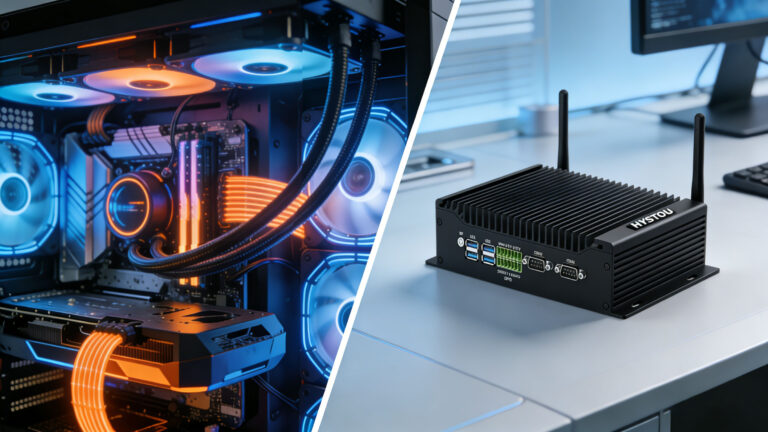
When choosing a new computer, most people naturally focus on the processor speed or RAM capacity. However, there is another critical factor that determines the longevity of your device: the cooling system. In fact, without proper thermal management, even the fastest CPU will slow down. Consequently, performance drops, and hardware can eventually fail.
Therefore, if you are looking for a reliable PC, you need to understand your cooling options. Currently, the debate is often between Liquid Cooling vs. Air Cooling. But, for industrial applications and Mini PCs, there is a third, superior contender: Fanless (Passive) Cooling.
In this guide, we will compare these three methods. Furthermore, we will explain why fanless technology is often the smarter choice for business environments.
Understanding the Three Main Cooling Methods
Before we compare them, let’s briefly look at how each system works. Specifically, we will look at Standard Air, Liquid, and Passive Cooling.
1. Active Air Cooling: The Standard Option
Generally speaking, active air cooling is the most common method found in home computers.
How it works:
It uses a metal heatsink placed on the CPU to draw heat away. Simultaneously, a fan blows air through the metal fins to push that heat out of the case.
The Upside: It is cost-effective and simple to install.
The Downside: Unfortunately, fans generate noise. Moreover, moving parts wear out over time. Most importantly, fans suck in dust, which can cause short circuits.
2. Liquid Cooling: The Gamer’s Choice
On the other hand, we have liquid cooling, also known as water cooling. This is popular among gamers.
How it works:
This system uses a pump to circulate coolant liquid through tubes. The liquid travels to a radiator, where fans blow air to cool it down. Finally, it cycles back to the CPU.
The Upside: It is extremely efficient for high-performance tasks like gaming.
The Downside: However, it is expensive and risky. For instance, if the liquid leaks, it can destroy the PC. Additionally, the pump requires maintenance.
3. Fanless (Passive) Cooling: The Industrial Choice
Finally, there is Hystou’s specialty: Fanless cooling.
How it works:
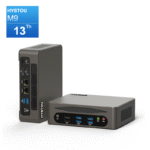
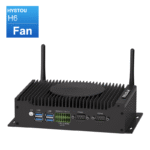
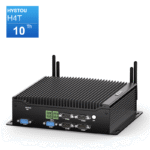
Unlike the other methods, fanless cooling removes the weakest link: the fan. Instead, the entire chassis of the Mini PC acts as a giant heatsink. Made of aluminum alloy, the case naturally absorbs and dissipates heat.
The Upside: First, it produces 0dB noise. Second, it requires zero maintenance. Third, because there is no airflow inside, no dust can enter.
The Downside: It is not designed for extreme overclocking, but it is perfect for stability.
Comparison: Liquid vs. Air vs. Fanless
To summarize the differences, let’s look at the comparison table below.
| Feature | Active Air Cooling | Liquid Cooling | Fanless (Hystou) |
| Noise Level | Moderate | Low (Pump noise) | Silent |
| Maintenance | Frequent (Dusting) | High (Leak checks) | Zero Maintenance |
| Reliability | Medium | Risk of leakage | Ultra High |
| Dust Risk | High | High | None (Sealed) |
| Best For | Home Office | Gaming | Industry / Business |
Why Fanless Cooling Wins for Business & Industry
Although liquid cooling looks impressive, it is not practical for professional environments. For this reason, Hystou recommends Fanless Air Cooling for industrial use. Below, we highlight three key reasons why.
1. The "Dust Killer" Advantage
First of all, dust is the enemy of electronics. In factories or warehouses, active fans act like vacuum cleaners. As a result, they suck dust and moisture into the computer. Eventually, this causes overheating. In contrast, Hystou Fanless PCs are fully sealed. Therefore, dust simply cannot get inside.
2. Zero Mechanical Failure
Secondly, fans are mechanical parts. Over time, bearings dry out and motors burn out. Because of this, standard PCs require frequent repairs. However, fanless systems utilize solid-state physics. An aluminum block never fails. Thus, they are perfect for 24/7 operations.
3. Absolute Silence
Lastly, noise pollution is a real issue. For libraries or quiet offices, the hum of a fan is distracting. Hence, a fanless PC offers a completely silent experience.
Which Should You Choose?
Choose Liquid Cooling if: You are building a massive tower PC specifically for playing AAA games at maximum settings and don’t mind the maintenance risk.
Choose Active Air Cooling if: You are on a very tight budget and don’t mind the noise or occasional cleaning.
Choose Fanless Cooling (Hystou) if: You need a reliable, durable computer for work, industrial control, or media playback. If you want a “set it and forget it” device that runs 24/7 without maintenance, Fanless is the only logical choice.
Ready to experience the reliability of Fanless Technology?
Explore our range of [Industrial Fanless Mini PCs] or [Contact Our Team] to find the perfect customized solution for your specific requirements.

HYSTOU
HYSTOU has established its R&D headquarters in Shenzhen, drawing on over a decade of experience. Our core team members, who previously served at renowned companies such as Inventec and Quanta Computer, form the backbone of our technical expertise. With robust R&D and innovation capabilities, we remain steadfast in our commitment to pursuing excellence in the field of technology products.